
TL;DR
A human-written essay can be flagged as AI because AI detectors classify patterns in text rather than directly proving who wrote it.
If your essay is flagged:
- Don’t deliberately add mistakes or replace random words to chase a lower score.
- Check whether the writing is generic, repetitive, formulaic, or light on analysis.
- Strengthen your thesis, evidence, examples, and course-specific reasoning.
- Verify every citation and factual claim.
- Review any grammar, paraphrasing, or rewriting changes carefully.
- Keep outlines, drafts, notes, sources, and version history.
- Check your course or institution’s current AI-use rules before submitting.
Most importantly, don’t make “0% AI” your goal.
Make the goal a paper that clearly reflects your reasoning, evidence, understanding, and writing process.
I Wrote the Essay Myself. Why Is It Being Flagged?
You write the essay yourself, then spend another hour tightening the grammar, sharpening the introduction, improving transitions, and removing sentences that sound awkward.
When you finally run the paper through an AI detector, the result is not what you expected:
62% AI-generated.
You revise several passages and check again. Somehow, the percentage rises.
At that point, it is easy to wonder whether polished academic writing itself has become suspicious. It hasn’t.
What has happened is much simpler: a detector has classified your text. It has not watched you research the topic, seen your notes, followed your revisions, or reconstructed who actually made the intellectual decisions behind the paper.
That distinction matters.
Turnitin’s current guidance says its AI-writing model can misidentify human-written and AI-written text and should not be used as the sole basis for adverse action against a student. Harvard’s Derek Bok Center likewise warns that AI checkers are not reliable evidence on their own, while Vanderbilt says there is currently no foolproof method for detecting generative-AI use.
So if your essay is flagged, the first question should not be:
How do I force the score down?
A more useful question is:
What, if anything, does this paper genuinely need me to review?
That change in question can save you from damaging a perfectly good essay just to satisfy a classifier.
What Does an AI Detection Score Actually Mean?
An AI score looks more certain than it really is.
If a report says 62% AI, students often read that as:
There is a 62% chance AI wrote my essay.
That is not how Turnitin describes the number.
Its AI-writing percentage represents the proportion of qualifying prose that its model predicts is likely to have originated from a large language model. The AI-writing score is also separate from Turnitin’s similarity score.
In other words, the percentage describes the detector’s classification of parts of the text. It is not a mathematical probability that a particular student cheated.
Turnitin is unusually explicit about this limitation: its AI report is intended to be one data point, not a verdict. Educators are expected to combine the report with their knowledge of the student, the assignment, institutional policy, and other evidence.
Why Turnitin doesn’t show exact scores below 20%
For newly generated reports, Turnitin does not surface an exact score when AI detection falls between 1% and 19%. Instead, it displays an asterisk.
The company says false positives occur more frequently in that range, so hiding the precise percentage is intended to reduce overinterpretation.
This is useful context, but it should not be reversed into another bad assumption:
A score above 20% is not automatically proof of AI use.
The report still requires human judgment.
One Distinction Most “AI Flag” Advice Misses
When an essay is flagged, students often mix together two very different questions:
Question 1: Why did this detector produce this score?
Unless the detector publishes a sufficiently detailed and independently validated explanation, you usually cannot identify a single sentence and say with certainty, “This exact feature caused the flag.”
Question 2: Is there anything weak or suspicious about the essay itself?
This question is much more useful.
You can inspect whether the paper is overly generic, formulaic, poorly evidenced, inconsistent with the assignment, dependent on automated rewriting, or full of citations you have not verified.
Those weaknesses matter even if they had nothing to do with the detector score.
That is the approach used throughout this guide. The 11 patterns below are not presented as a secret recipe for reverse-engineering Turnitin. They are things worth checking because they can make academic writing weaker, less personal to the assignment, harder to defend, or more difficult for an instructor to evaluate confidently.
11 Reasons Worth Checking When Your Essay Is Flagged as AI
1. Your Introduction Could Belong to Almost Any Essay
Consider this opening:
Technology has become an important part of modern society. Over time, technological developments have significantly influenced how people live and communicate. Therefore, it is important to examine both the advantages and disadvantages of technology.
The grammar is fine. The problem is that almost nothing in the paragraph belongs specifically to this essay.
Replace technology with social media, globalization, or artificial intelligence, and most of the paragraph still survives.
That usually signals a more important writing problem: the introduction has not yet reached the actual intellectual question.
Make the argument visible sooner
Compare it with:
Universities are increasingly incorporating generative AI into teaching, research, and assessment, but rules governing student use still vary across courses and assignments. The important question is therefore not whether students will encounter AI, but which forms of assistance support learning and which begin to replace the judgment an assessment is meant to test.
This version gives the reader something to think about. It introduces a specific context, a tension, and the direction of the argument.
Try this test: replace your topic with a completely different subject. If the introduction still mostly works, it probably needs more specificity.
2. Every Paragraph Is Built From the Same Template
Paragraph frameworks such as PEEL can be useful while learning academic structure. They become less useful when the framework starts showing through the prose.
If every paragraph sounds like this—
One important reason is…
For example…
This demonstrates that…
Furthermore, another important reason is…
—the reader begins to see the template instead of the argument.
A mature essay does not abandon structure. It allows different ideas to require different structures.
A paragraph presenting evidence may begin with a finding. A counterargument may begin by conceding a reasonable opposing view. A comparison paragraph may begin with the disagreement between two researchers. A limitations paragraph may start where the evidence becomes uncertain.
The principle is simple:
Use structure to serve the reasoning, not reasoning to fill the structure.
3. The Essay Has Rhythm, but No Movement
Sentence variety is often discussed as if students should mechanically alternate between short and long sentences.
That is not the goal.
Consider:
Artificial intelligence affects education in several ways. It provides students with useful tools. These tools can help students complete academic tasks. They can also improve educational outcomes.
The sentences are clear, but the idea barely develops.
Now compare:
AI can make some academic tasks faster, but speed is not automatically the same as learning. A student who generates an instant literature summary, for example, may finish the reading stage sooner while missing the disagreement between two researchers—the very disagreement the assignment was designed to make them notice.
The second version has more natural rhythm because the thinking moves: claim → qualification → example → implication.
That is a better way to improve sentence variety. Don’t make sentences different merely to make them different. Give each sentence a different intellectual job.
4. You’re Trying to “Sound Academic” Instead of Being Precise
A common revision mistake is to treat complexity as sophistication.
So:
“helps”
becomes:
“facilitates the enhancement of”
And:
“shows”
becomes:
“serves as a compelling testament to”
Neither revision necessarily makes the argument stronger.
Academic writing earns authority through accuracy. Sometimes the right word is technical and specialized; sometimes it is remarkably ordinary.
Before replacing a simple word with a more impressive one, ask:
What exactly am I trying to claim?
If a study suggests a relationship, don’t write that it proves one. If a factor contributes to an outcome, don’t automatically say it causes the outcome.
Precision is more academic than decoration.
5. Your Transitions Announce Movement Without Explaining It
Words such as furthermore, moreover, additionally, and consequently are not bad words.
The problem is what happens when they do work that the argument itself should be doing.
Compare:
Furthermore, Smith argues that…
with:
Smith reaches a different conclusion because his study measures academic performance rather than students’ perceptions of performance.
The second sentence does more than introduce another source. It tells the reader why that source belongs here.
Good transitions answer questions such as:
- Is this evidence supporting the previous point?
- Complicating it?
- Contradicting it?
- Narrowing it?
- Showing an exception?
- Changing the scale of the discussion?
When the relationship is clear, you often need fewer transition words.
6. Your Sources Are Doing All the Thinking
A paper can contain ten citations and still have very little analysis.
Consider:
Smith (2023) argues that social media affects attention. Jones (2024) also discusses reduced concentration. Brown (2022) finds that digital technology affects students. These studies show that social media has significant effects.
The sources appear one after another, but the student’s reasoning remains almost invisible.
After an important citation, ask:
What am I doing with this evidence?
Perhaps you need to explain why it supports your thesis. Perhaps two studies use different definitions and should not be treated as equivalent. Perhaps the evidence establishes correlation but not causation. Perhaps the finding applies to first-year students but not necessarily to all university students.
Your academic voice is not a special vocabulary.
It is the pattern of judgments you make about evidence.
7. Your Examples Could Have Been Written Without Understanding the Subject
Generic examples often create the appearance of explanation without actually proving comprehension.
Compare:
AI can help students learn by providing personalized assistance.
with:
A first-year biology student who understands the broad stages of mitosis but repeatedly confuses prophase with metaphase could turn their own lecture notes into a comparison table, then check that table against the assigned textbook before using it to revise.
The second example has a learner, a specific difficulty, an action, and a verification step.
That matters because useful examples reveal whether the writer understands how an idea works in practice.
A simple formula can help:
person + problem + context + action + consequence
You do not need to force that structure into every paragraph. But when an argument feels vague, a specific example often exposes what you actually mean.
8. The Final Paper No Longer Sounds Like Writing You Understand
An instructor who has read several pieces of your work has context that an AI detector does not.
A sudden change in vocabulary, syntax, conceptual sophistication, or tone can therefore prompt questions, even though a stylistic change alone does not prove AI use. Vanderbilt explicitly recommends considering significant differences from a student’s previous work alongside other evidence.
The issue is not that students must write at the same level forever. Good students improve.
The question is whether the final language is still language they genuinely control.
Suppose your earlier writing says:
One weakness in this argument is that it assumes every student has equal access to technology.
and the new paper suddenly says:
This paradigmatic conceptualisation necessitates a nuanced interrogation of technological accessibility across heterogeneous learner populations.
The second sentence is not automatically better. If you would struggle to explain why each term is there, the revision has moved beyond clarity into performance.
Use the strongest language you can own, not the strongest language a tool can generate.
9. You Wrote the Draft but Automatically Rewrote Large Sections
This is an important gray area.
A student can genuinely write an entire first draft, then run large sections through a rewriting or paraphrasing tool. The original ideas may still belong to the student, but the surface language can change substantially.
Turnitin’s current report includes categories for text it identifies as likely AI-generated and text it identifies as likely AI-generated and subsequently AI-paraphrased.
Detection aside, wholesale rewriting creates a more basic academic risk: you can lose control of your own meaning.
Automated changes may alter:
- the strength of a claim;
- technical terminology;
- cause and correlation;
- quotations;
- source attribution;
- disciplinary conventions;
- or the relationship between evidence and conclusion.
A safer revision loop is:
Your sentence → identify the problem → review a suggestion → compare meanings → revise deliberately
rather than:
Entire essay → rewrite → submit
10. Your Citations Fail a Reality Check
If you are worried about an AI percentage, this is the section to take most seriously.
A questionable detector classification is probabilistic. A nonexistent source is not.
Generative AI systems can produce plausible-looking references, inaccurate bibliographic information, or claims that the linked source does not actually support. Harvard and Vanderbilt both identify fabricated or unverifiable citations as a much more meaningful academic-integrity concern than isolated stylistic features.
Before submitting, verify every important reference:
- Does the source exist?
- Did you actually read it?
- Is the author correct?
- Is the title correct?
- Is the publication year correct?
- Can you locate the passage supporting your claim?
- Does the source say what your sentence says it says?
- Is a quotation exact?
- Have you represented the source’s level of certainty fairly?
This is not detector optimization.
It is basic scholarly responsibility.
11. Your Essay Doesn’t Show Enough Evidence of This Assignment
Imagine that the assignment asks you to use three prescribed readings, apply a framework introduced in lectures, analyze a particular case, and answer a tightly defined question.
Your essay is fluent. It is well organized. It contains sensible general information.
But almost none of it could only have been written by a student who took this course and completed this assignment.
That is a weakness regardless of how the text was produced.
Vanderbilt recommends looking at whether a submission meaningfully incorporates course teaching when concerns about inappropriate AI use arise. Harvard similarly cautions that isolated stylistic features are weak evidence and encourages attention to more substantive issues.
The practical lesson is valuable even if nobody suspects AI:
Don’t merely write about the topic. Answer the assignment.
Use the required concepts. Engage the assigned sources. Apply the framework. Address the exact question. Show what you learned in this context.
How to Review a Flagged Essay Without Ruining It
A high AI score can make students revise in panic. That is when good writing often gets worse.
Instead of editing everything, work from the highest-value questions downward.
1. Start with the assignment, not the detector
Put the AI score aside temporarily and reopen the brief.
What exactly are you being graded on?
Highlight:
- the task verb;
- the required concepts;
- required sources;
- assessment criteria;
- formatting rules;
- and any AI-use policy.
Now compare the paper against those requirements.
A detector can tell you what its model predicts. It cannot tell you whether your essay actually answers the question well.
2. Write your thesis from memory
Close the document and explain your argument in one or two sentences.
If you cannot do that, the problem may be deeper than wording.
Now look at the thesis in the essay. Does it match the argument you think you are making?
A surprising number of papers become generic because the writer keeps polishing sentences before deciding exactly what the paper is trying to establish.
3. Give every paragraph a job
In the margin, summarize each body paragraph in a few words:
- establishes mechanism;
- presents evidence;
- challenges Smith;
- applies framework;
- considers exception;
- explains limitation;
- answers counterargument.
If several paragraphs have essentially the same label, you may have repetition disguised as length.
If a paragraph has no clear job, ask why it is there.
4. Run the “evidence-to-reasoning” check
For every important citation, identify four things:
Claim → Evidence → Interpretation → Relevance
For example:
Claim: Frequent task switching may reduce sustained attention during study.
Evidence: Study X reports…
Interpretation: This suggests…
Relevance: That matters to this essay because…
You do not need to write those labels into the final paper. They are a diagnostic.
If you cannot complete the chain, you have probably found a section worth revising.
5. Check what only you—or a student in your course—could have contributed
This is the most useful originality test in the article.
Take a body paragraph and ask:
Could almost anyone who spent ten minutes searching this topic have written this?
If yes, don’t reach for synonyms. Look for missing intellectual material.
| If the paragraph lacks… | Add… |
|---|---|
| Specificity | A precise concept, mechanism, event, text, case, or example |
| Evidence | Verified research, data, quotation, or assigned reading |
| Analysis | Your explanation of why the evidence matters |
| Comparison | A meaningful point of agreement or disagreement |
| Qualification | Where the claim becomes weaker or stops applying |
| Course connection | The relevant framework, lecture, case, or assigned source |
| Position | What you conclude from the evidence |
| Limitation | What the evidence cannot establish |
Notice what is absent from this table:
deliberate mistakes.
You do not prove authorship by making the writing worse. You make your contribution clearer by making the thinking more visible.
Before and After: What “More Human” Should Actually Mean
Consider this paragraph:
Social media has many advantages and disadvantages for university students. It helps students communicate with others and access useful information. However, it can also cause distraction and negatively affect academic performance. Therefore, students should use social media responsibly.
There is nothing obviously wrong with the grammar.
The weakness is intellectual. The paragraph makes broad claims, offers no evidence, and ends with advice that could have appeared in almost any essay about social media.
Now compare:
The academic effect of social media depends partly on the kind of interruption it creates. A student who opens a course discussion group twice during an evening is not working under the same conditions as one who responds to notifications every few minutes. Research that treats both patterns simply as “screen time” may therefore obscure an important distinction between purposeful use and repeated task switching.
What improved?
The revision introduces a distinction, a concrete scenario, an analytical limitation, and a more precise claim.
That is a useful definition of “humanizing” academic writing:
not adding noise, but adding judgment.
What Not to Do Just Because an AI Detector Flagged You
Some responses to an AI score can create a worse paper—or a worse academic-integrity problem—than the original flag.
| Don’t | Why it fails | Do this instead |
| Add spelling or grammar mistakes | Poor language does not prove human authorship | Keep the writing accurate and natural |
| Replace words with random synonyms | Meaning and terminology can become distorted | Revise for precision, not novelty |
| Rewrite every sentence | You may destroy strong analysis just to chase a classifier | Diagnose specific weaknesses first |
| Run the paper through multiple “humanizers” blindly | Each rewrite can move the language farther from your original reasoning | Review changes section by section |
| Invent drafts after being questioned | Fabricated evidence creates a separate integrity problem | Preserve genuine notes and version history |
| Treat one detector as ground truth | Different systems can classify text differently | Prioritize evidence, process, policy, and instructor judgment |
| Assume polished English is the problem | Clear writing is not misconduct | Keep improving clarity while preserving meaning |
What If You Really Did Write the Essay Yourself?
If the work is yours, the most important thing you can preserve is not a better detector score.
It is your authorship trail.
Keep genuine evidence of how the paper developed:
- assignment notes;
- brainstorming;
- research notes;
- source PDFs;
- outlines;
- earlier drafts;
- document version history;
- tracked changes or comments;
- citation-manager records;
- and any required disclosure of permitted AI assistance.
Then make sure you understand the final paper well enough to discuss it.
You should be able to explain why you chose a particular source, why one paragraph follows another, where your thesis changed during drafting, which evidence is strongest, and what limitation you would acknowledge if challenged.
That is not a trick for “proving you are human.”
It is what genuine intellectual ownership looks like.
What Should You Say If an Instructor Questions Your Essay?
An accusation—or even a request to discuss your work—can feel personal. A defensive response usually makes the conversation harder.
Stay factual and bring evidence.
You might say:
I understand why you want to review the assignment. I wrote the paper myself and I’m happy to explain how I researched, drafted, and revised it. I also have my notes, sources, earlier drafts, and version history. Could we look at the specific sections that raised concerns and review them alongside the course policy?
If you used an AI or writing tool in a way the assignment permits, describe that use accurately.
For example:
I wrote the argument and original draft myself. I used [tool] for [permitted purpose], reviewed the changes, and can show the earlier version and my notes.
Do not claim that you used no AI if you did.
Transparency is much easier to defend than an explanation you have to keep reconstructing.
What About International Students and False Positives?
This issue deserves more care than a generic warning.
A widely discussed 2023 study by researchers including Weixin Liang and James Zou tested seven GPT detectors on writing by non-native English speakers. The researchers found substantial misclassification in the systems they evaluated, raising concerns about detector bias against non-native-English writing.
That study should not be turned into an equally broad claim that every current detector is biased in exactly the same way. Detector models change, and vendors conduct their own evaluations.
The responsible conclusion is narrower:
False-positive risk and fairness deserve scrutiny, particularly when detector output could affect a student’s academic standing.
For international students, the solution is not to make academic English deliberately less correct.
If a writing tool changes:
“The results suggest an association between…”
into:
“The results clearly prove that…”
you should reject the change when the research supports only an association.
That decision demonstrates more than language proficiency. It shows that you understand the evidence and control the claim.
For many students, the challenge is not lack of knowledge. It is expressing existing knowledge clearly in academic English without allowing the language-editing process to change the underlying meaning.
That is exactly where writing support should help.
Your Course’s AI Policy Matters More Than Any Detector Score
There is no universal rule for acceptable AI use in academic work.
The same action—using AI to brainstorm, translate, edit grammar, summarize notes, or restructure a paragraph—may be allowed in one course and prohibited in another.
Oxford’s current summative-assessment policy, for example, requires assessment setters to specify whether and how AI may be used, and students must follow the rules attached to each particular assessment. The policy also requires disclosure where AI use is permitted and a declaration is prescribed.
Before using AI or automated rewriting on assessed work, check:
- the assignment instructions;
- the syllabus or course handbook;
- departmental guidance;
- your institution’s academic-integrity policy;
- the rules for that specific assessment;
- any required AI-use declaration.
If the wording is unclear, ask the person responsible for the assignment.
A detector score, an AI company’s marketing page, a Reddit thread, or this article cannot override your institution’s rules.
A Better Diagnostic: Separate Writing Risk From Authorship Evidence
Here is a framework worth saving.
When a paper gets flagged, review it on two axes.
| Strong authorship evidence | Weak authorship evidence | |
| Strong essay | Usually a process/documentation question rather than a reason to damage the prose | Preserve evidence now; make sure you can explain your reasoning and sources |
| Weak essay | Improve the academic weaknesses, but don’t confuse them with proof of AI use | Highest-priority case: strengthen the paper and preserve/document the genuine process |
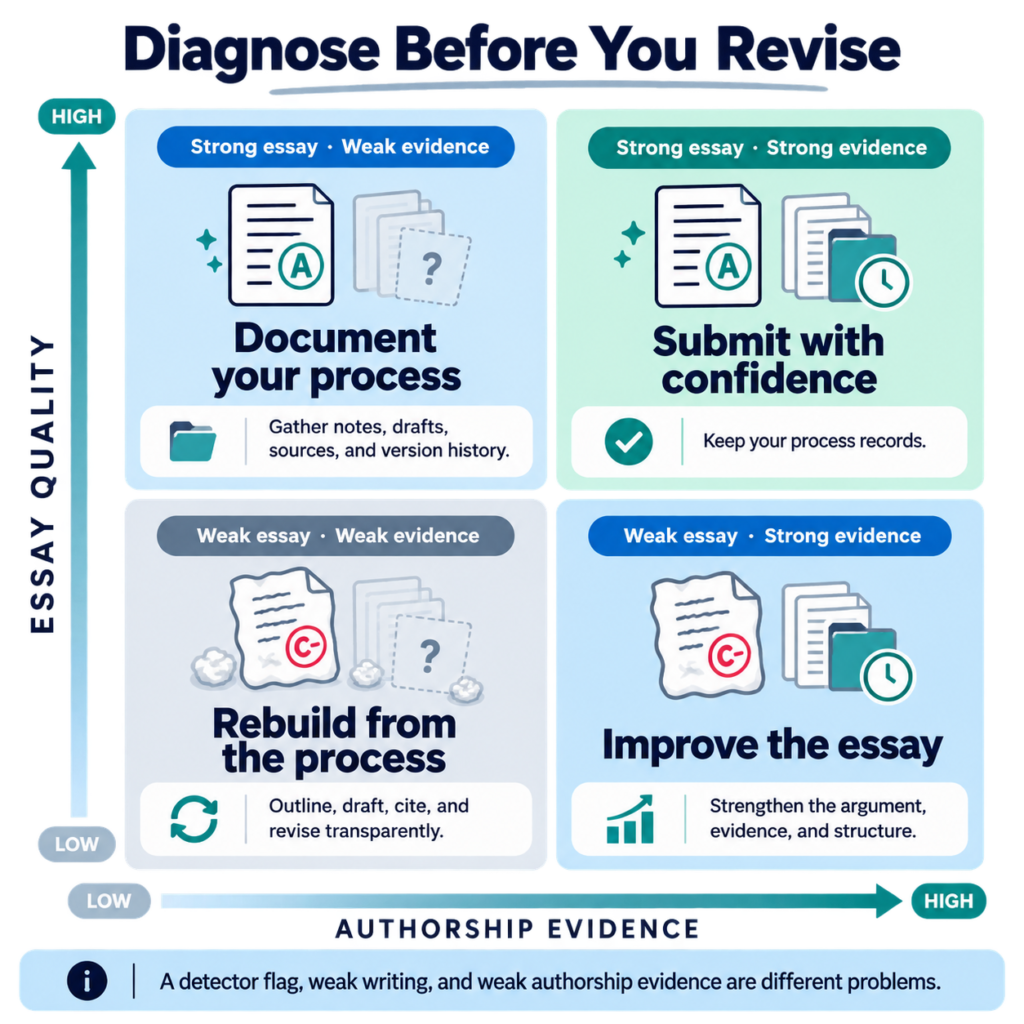
This distinction prevents a common mistake: treating every detector flag as a writing problem and every writing problem as evidence of AI.
They are not the same thing.
A Responsible Conch Workflow for a Flagged Draft
The wrong workflow is:
Detector score → panic → rewrite everything → check score → rewrite again
A more useful workflow is:
Assignment → reasoning → evidence → diagnosis → targeted revision → verification → final review
Here is how Conch can fit into that process without replacing the student’s judgment.
1. Bring the original material
Start with the assignment instructions, your notes, your sources, your argument, and your draft.
That context matters. Polishing sentences without understanding what the assignment requires can make a paper smoother while making it academically weaker.
2. Diagnose before rewriting
Use writing-analysis tools to find sections that deserve attention—for example, repetitive phrasing, uniform sentence patterns, unclear transitions, or limited vocabulary variety.
A flagged pattern is not automatically a bad sentence. Treat it as a prompt to inspect the passage.
3. Revise the specific problem
If a paragraph genuinely needs clearer phrasing, better flow, or a more natural academic tone, use Conch Rewrite Mode on that section rather than replacing the entire paper.
Then compare the revision with your original.
Did the claim become stronger than the evidence supports? Did technical language change? Did a qualification disappear? If so, revise again or keep your original wording.
4. Reconnect the language to the thinking
After improving the prose, return to the argument.
Can you explain what this paragraph contributes?
Can you defend the evidence?
Does it use the relevant course material?
Does it still sound like something you would naturally say when discussing the topic?
5. Verify before submitting
Check important facts, quotations, citations, and references against the original sources.
Conch can support the review process. The final academic decisions remain yours.
Review your draft, not just a detector score
If your paper feels generic, repetitive, or overly polished in places, use Conch Rewrite Mode to examine the sections that genuinely need revision while keeping control of the argument and final meaning.
Review My Draft With Conch →
Your reasoning stays yours. The writing gets clearer.
The Pre-Submission Test That Matters More Than “0% AI”
Before you submit, ask yourself:
- Can I state my thesis without reading it?
- Does each paragraph have a clear purpose?
- Do I know where every important claim came from?
- Have I verified my quotations and references?
- Does the paper use the course material the assignment requires?
- Can I explain why I chose each major source?
- Can I defend the interpretation I give that source?
- Did I review automated changes rather than accepting them blindly?
- Does my AI use, if any, comply with this assignment’s rules?
- Do I have genuine evidence of how the work developed?
If the answer is yes, you have addressed questions that matter far more to academic authorship than whether one classifier returns 0%, 17%, or 62%.
Frequently Asked Questions
Can a human-written essay be flagged as AI?
Yes. AI-detection systems can produce false positives. Turnitin states that its model may misidentify human-written text and should not be used as the sole basis for adverse action against a student.
Why does Turnitin think I used AI?
Turnitin’s model analyzes qualifying prose and predicts whether portions are likely to have originated from a large language model. The resulting percentage is a classification of text, not direct evidence of who wrote the paper or a probability that a student cheated.
What does a Turnitin AI percentage mean?
It represents the percentage of qualifying prose that Turnitin’s model identifies as likely AI-generated. It is separate from the similarity score and should be interpreted alongside other evidence and institutional policy.
Why doesn’t Turnitin show exact AI scores below 20%?
For new reports, Turnitin does not display exact percentages from 1% to 19%. It uses an asterisk because its testing found a higher incidence of false positives in that range.
Does a Turnitin score above 20% prove AI use?
No. Turnitin itself says its AI-writing model may make mistakes and should not be used as the sole basis for action against a student.
Why does my writing sound AI-generated even though I wrote it?
Sometimes polished academic writing becomes generic because it relies on broad introductions, predictable paragraph templates, stock transitions, vague examples, or sources without enough analysis. Those are useful writing problems to fix, but none is proof that AI wrote the paper.
How do I stop my essay from being flagged as AI?
There is no responsible way to guarantee a particular detector result. Focus instead on strengthening specific reasoning, evidence, course context, examples, source accuracy, and your control over the final language. Keep genuine evidence of your writing process as well.
Should I add mistakes to make my essay look human?
No. Misspellings and grammatical errors do not establish human authorship. They simply make your paper weaker.
Should I use an AI humanizer if my paper is flagged?
Do not automatically rewrite an entire paper just to chase a lower score. First identify whether the writing actually has a problem. If your course permits rewriting assistance, review every change for meaning, evidence, terminology, citations, and tone.
Can Grammarly or another editing tool affect an AI detector score?
Automated editing can change the surface language of a paper, and different detectors may respond differently to revised text. That does not mean every grammar correction will cause a flag. What matters academically is whether the tool use is permitted and whether you retain control of the final meaning.
What should I do if I’m falsely accused of using AI?
Review your institution’s academic-integrity process, ask which aspects of the paper raised concern, and provide genuine evidence of your work where appropriate—such as notes, sources, drafts, version history, and your ability to explain the paper’s argument.
A Better Goal Than “0% AI”
The attraction of an AI score is that it turns a complicated question into a simple number.
0% looks safe.
62% looks dangerous.
But authorship is not a percentage.
A strong academic paper leaves a much richer trail: the question you chose to answer, the evidence you trusted, the sources you rejected, the distinction you noticed, the paragraph you rewrote because the first argument did not work, and the limitation you added because the evidence could not support the stronger claim.
That is what makes a paper yours.
So if an AI detector flags your essay, do not immediately start performing for the algorithm.
Read the assignment again. Check the argument. Verify the sources. Look for generic reasoning. Restore details that matter. Review automated edits. Keep your drafts.
Then submit a paper you understand well enough to stand behind.
Final CTA
Before You Rewrite Your Essay, Find Out What Actually Needs Work
Use Conch Rewrite Mode to review sections that feel generic, repetitive, awkward, or unclear—then decide which changes genuinely improve your writing.
Review My Draft With Conch →
Clearer language. Stronger reasoning. Your final judgment.
Recommended Internal Links
- Conch AI Detector from the section explaining what detector scores mean.
- AI Phrase Detector from the diagnostic section on repetitive language.
- Sentence Burstiness Analyzer from the section on sentence rhythm.
- Word Variety / Perplexity Checker from the language-diagnosis workflow.
- Conch Rewrite Mode from the targeted-revision workflow and final CTA.
- Responsible AI / AI Detection pillar from the university-policy section.
Related Reading
- How to Calculate H Index
- How to Write an Informative Essay
- Technology Essay
- How to Write a Header for an Essay
- How to Write a Biography Essay
- How to Write a Reflection Paper
- How to Write an Encyclopedia Entry
- Speech Analysis Example
- What is a Good H Index
- How to improve Academic Writing
- How to use Ai for Essay and Research Papers Ethically
Leave a Reply