
Choosing an informative essay topic for college isn’t just about finding something interesting. You need a subject that is specific enough to explain within your word count, supported by credible sources, and complex enough for college-level research.
That can be harder than it sounds.
Choose something too broad—like artificial intelligence or climate change—and your essay can become a collection of disconnected facts. Choose something extremely narrow, and you may struggle to find enough reliable evidence.
This guide gives you 100 informative essay topics for college students, organized by subject, plus easy, current, and advanced ideas. You’ll also learn how to narrow a broad topic, test whether an idea is researchable, and choose a topic that fits your essay length.
TL;DR: 15 Good Informative Essay Topics for College Students
Need a topic quickly? Start with one of these:
- How generative AI is changing academic research workflows
- How sleep affects learning and memory in college students
- How social media recommendation algorithms select content
- How antibiotic resistance develops and spreads
- How renewable energy is integrated into electrical grids
- How telemedicine is changing access to healthcare
- How misinformation spreads through social networks
- How CRISPR gene editing works
- How student loan interest affects long-term repayment
- How remote work has changed organizational communication
- How facial recognition systems identify people
- How urban heat islands develop
- How the gut microbiome interacts with human health
- How central banks use interest rates to influence inflation
- How artificial intelligence is used in medical imaging
The best choice isn’t necessarily the most complicated one. It’s the topic you can explain clearly, research credibly, and cover properly within your assignment.
Related Reading
- Essay on Respect
- Essay About Bullying
- Why I Deserve This Scholarship Essay
- Is Census Data Primary or Secondary
- Is a Documentary a Primary Source
- Are Textbooks Primary Sources
- Essay About Death
- How to Write a 4 Paragraph Essay
- Finance Research Paper Writing
What Makes a Good Informative Essay Topic for College?
A strong college-level topic should give you enough depth to research without becoming so broad that you can’t explain it properly.
A useful research question should be clear and focused enough to address within the available space. George Mason University’s Writing Center also recommends preliminary research as part of narrowing a general topic into a workable research question.
1. Make It Specific
Compare:
Too broad: Artificial intelligence
Better: Artificial intelligence in healthcare
Focused: How artificial intelligence is used to analyze medical images
The focused version tells you what to research—and what doesn’t belong in the essay.
2. Check That Credible Research Exists
Before committing to a topic, search:
- your university library;
- Google Scholar;
- peer-reviewed journals;
- government publications;
- university research centers;
- professional or scientific organizations; and
- original reports or datasets when appropriate.
Don’t judge a topic by the number of ordinary search results it produces. What matters is whether you can find credible evidence that actually helps answer your question.
3. Match the Topic to Your Word Count
A 750-word essay can’t explain the entire history, technology, ethics, regulation, and future of artificial intelligence.
It could explain how large language models generate text or how AI is used to analyze medical images.
4. Make Sure You Can Explain Rather Than Only Argue
Compare:
Argumentative: Universities should ban facial recognition.
Informative: How facial recognition technology is used on university campuses.
The second gives you room to explain the technology, applications, policies, and concerns without requiring the entire essay to defend one position.
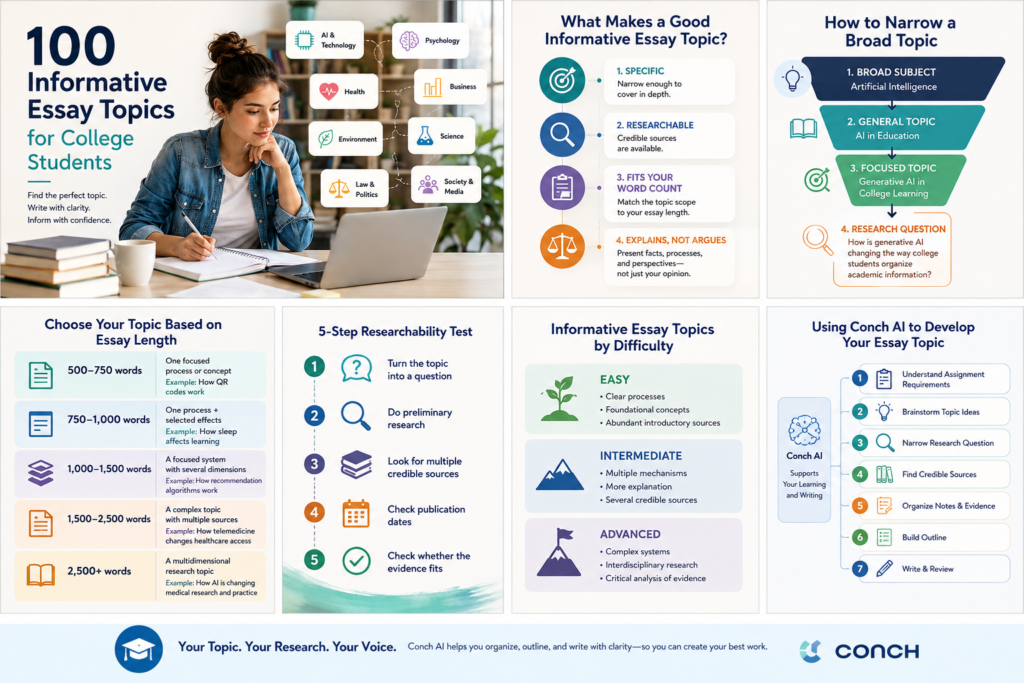
100 Informative Essay Topics for College Students
AI and Technology Informative Essay Topics
1. How Generative AI Produces Text
Explain how large language models process input and generate text.
2. How AI Is Used in Medical Imaging
Explore how machine-learning systems can assist professionals in analyzing medical images.
3. How Recommendation Algorithms Select Online Content
Explain how platforms use different signals to determine what content users encounter.
4. How Facial Recognition Technology Works
Explore facial detection, feature extraction, matching, and common applications.
5. How Deepfakes Are Created and Detected
Explain technologies used to create synthetic media and methods used to identify manipulated content.
6. How Cloud Computing Works
Explain how remote computing infrastructure provides storage, processing power, and software services.
7. How Edge Computing Supports Connected Devices
Explore why some information is processed closer to a device instead of being sent to a distant cloud server.
8. How Quantum Computing Differs From Classical Computing
Introduce qubits and the basic principles that distinguish quantum computation from conventional computing.
9. How Blockchain Records Transactions
Explore distributed ledgers, cryptographic verification, and consensus mechanisms.
10. How Generative AI Is Changing Academic Research Workflows
Examine how AI-assisted tools are being explored for tasks such as literature discovery, organization, transcription, and analysis—and why human verification remains important.
Education and College Life Informative Essay Topics
11. How Sleep Affects Learning and Memory in College Students
Explore relationships among sleep, attention, memory, and learning.
12. How Spaced Repetition Supports Long-Term Learning
Explain why information reviewed across multiple sessions may be easier to retain.
13. How Retrieval Practice Supports Learning
Explore the difference between actively recalling information and simply rereading material.
14. How Online Learning Platforms Measure Student Engagement
Explain what kinds of activity data digital learning platforms can collect and how institutions may interpret them.
15. How Academic Peer Review Works
Explain how scholarly research moves through submission, evaluation, revision, and publication.
16. How University Financial Aid Is Calculated
Explain the major factors used to determine financial need and aid eligibility within a specific country or system.
17. How Student Loan Interest Accumulates
Explore principal, interest, repayment periods, and borrowing costs.
18. How University Libraries Provide Access to Academic Research
Explain databases, journal subscriptions, repositories, interlibrary loans, and research support.
19. How Academic Citation Systems Work
Explore the purpose and major conventions of academic citation systems.
20. How AI Tools Are Being Used in Higher Education
Explore applications such as tutoring, feedback, research support, accessibility, and administration.
Health and Medicine Informative Essay Topics
21. How Antibiotic Resistance Develops
Explain how microorganisms can become resistant to medicines and how antibiotic misuse and overuse contribute to the development and spread of resistant pathogens.
22. How Vaccines Prepare the Immune System
Explain the basic relationship between vaccination, immune recognition, and immune memory.
23. How Telemedicine Works
Explore the technology and clinical processes used to provide selected healthcare services remotely.
24. How the Gut Microbiome Interacts With Human Health
Explain how researchers investigate microorganisms in the digestive system and their relationship with health.
25. How Sleep Supports Memory Formation
Explore what researchers have learned about sleep and memory consolidation.
26. How Organ Transplant Matching Works
Explain factors such as blood type, compatibility, allocation, and medical urgency.
27. How mRNA Technology Works
Explain how messenger RNA can provide biological instructions and how researchers use the technology in medicine.
28. How Wearable Devices Monitor Health
Explore how devices measure signals such as movement, heart rate, sleep, or blood oxygen.
29. How Chronic Stress Affects the Human Body
Explain physiological stress responses and what can happen when they remain activated for long periods.
30. How Medical Imaging Technologies Differ
Compare the basic principles behind X-rays, CT scans, MRI, and ultrasound.
Psychology Informative Essay Topics
31. How Human Memory Is Formed and Retrieved
Explore encoding, storage, consolidation, and retrieval.
32. How Habits Develop
Explain behavioral and psychological processes involved in habit formation.
33. How the Placebo Effect Works
Explore placebo responses and why researchers account for them in clinical studies.
34. How Digital Media Can Affect Attention
Examine research into digital media use, distraction, task switching, and attention.
35. How Cognitive Biases Affect Decision-Making
Explain several cognitive biases and how they can influence judgments.
36. How Procrastination Works
Explore psychological explanations involving motivation, emotion regulation, rewards, and task avoidance.
37. How Music Interacts With Emotion
Explain how researchers study relationships among music, memory, arousal, and emotional responses.
38. How Language Influences Cognition
Explore research into relationships among language, categorization, memory, and perception.
39. How Stress Can Influence Academic Performance
Examine relationships among stress, concentration, memory, and learning.
40. How Circadian Rhythms Regulate Sleep
Explore biological clocks, light exposure, hormones, and sleep-wake cycles.
Business and Economics Informative Essay Topics
41. How Central Banks Use Interest Rates to Influence Economic Activity
Explain how monetary-policy decisions can affect borrowing, spending, investment, and inflation.
42. How Global Supply Chains Work
Trace how raw materials, manufacturers, logistics companies, distributors, and retailers connect products with consumers.
43. How Dynamic Pricing Works
Explain why prices for flights, hotels, ride-sharing, or online products can change according to demand and other factors.
44. How Credit Scores Are Calculated
Explore the major factors used by a selected consumer credit-scoring system.
45. How Remote Work Changed Organizational Communication
Examine technologies and processes companies use to coordinate distributed teams.
46. How Subscription Business Models Work
Explain recurring-revenue models and why businesses use subscriptions.
47. How Digital Payment Systems Process Transactions
Trace what happens between a customer’s payment request and settlement.
48. How Behavioral Economics Explains Consumer Decisions
Introduce concepts that help explain why real-world financial decisions don’t always follow perfectly rational models.
49. How Startups Raise Venture Capital
Explain funding rounds, valuation, equity, and the role of investors.
50. How Supply-Chain Disruptions Can Affect Consumer Prices
Explain how shortages, transportation problems, production delays, and demand changes can influence prices.
Environment and Sustainability Informative Essay Topics
51. How Urban Heat Islands Develop
Explain why built-up areas can experience higher temperatures than surrounding areas.
52. How Microplastics Enter Marine Ecosystems
Trace common sources and pathways of small plastic particles into aquatic environments.
53. How Carbon Capture Technologies Work
Explain major approaches used to capture and store carbon dioxide.
54. How Renewable Energy Is Integrated Into Electrical Grids
Explore generation variability, energy storage, transmission, and grid management.
55. How Desalination Produces Fresh Water
Explain common technologies for removing salt from seawater.
56. How Electric-Vehicle Batteries Are Recycled
Explore collection, processing, material recovery, and potential reuse.
57. How Climate Change Affects Agricultural Production
Focus on temperature, rainfall, extreme weather, pests, or crop productivity.
58. How Green Roofs Affect Urban Environments
Explain how vegetated roofs can influence temperature, stormwater, and biodiversity.
59. How Food Waste Affects the Environment
Trace the resources used to produce discarded food and what happens when food waste enters disposal systems.
60. How Sustainable Aviation Fuel Is Produced
Explain major feedstocks and production pathways being developed as alternatives to conventional aviation fuel.
Society and Media Informative Essay Topics
61. How Misinformation Spreads Through Social Networks
Explore sharing behavior, recommendation systems, repetition, communities, and other factors involved in information diffusion.
62. How Influencer Marketing Works
Explain sponsorships, audience targeting, platform metrics, and advertising disclosures.
63. How Streaming Services Changed Media Consumption
Explore on-demand viewing, recommendation systems, distribution, and audience behavior.
64. How Podcasts Became a Major Media Format
Trace developments in podcast technology, distribution, monetization, and audience growth.
65. How Online Communities Develop Social Norms
Explore moderation, group identity, platform rules, and community behavior.
66. How Digital Privacy Laws Regulate Personal Data
Choose a specific privacy framework and explain how it addresses data collection, storage, consent, and individual rights.
67. How News Organizations Verify User-Generated Content
Explore methods journalists use to check photos, videos, locations, timestamps, and eyewitness claims.
68. How Social Media Platforms Moderate Content
Explain automated systems, human review, platform policies, and appeals.
69. How Memes Function as Digital Communication
Explore how images, text, references, and cultural context allow memes to communicate ideas.
70. How Digital Communication Changes Language
Examine abbreviations, emojis, internet slang, memes, and other features of online language.
Science Informative Essay Topics
71. How CRISPR Gene Editing Works
Explain how CRISPR-based techniques can target particular genetic sequences.
72. How Black Holes Form
Explore stellar evolution, gravitational collapse, and the characteristics scientists use to describe black holes.
73. How Scientists Detect Exoplanets
Explain methods such as transit observations and radial-velocity measurements.
74. How Nuclear Fusion Produces Energy
Describe the process of combining atomic nuclei and why scientists are researching controlled fusion.
75. How DNA Sequencing Works
Explain how scientists determine the order of nucleotides in genetic material.
76. How Scientists Reconstruct Past Climates
Explore evidence from ice cores, tree rings, sediments, and other climate proxies.
77. How Earthquake Early-Warning Systems Work
Explain seismic waves, sensor networks, automated alerts, and the limits of early-warning systems.
78. How Satellites Monitor Earth’s Climate
Explore remote sensing of temperature, ice, vegetation, oceans, atmospheric gases, and other indicators.
79. How Bioluminescence Works
Explain how organisms produce light and the functions bioluminescence can serve.
80. How Scientists Estimate the Age of Ancient Materials
Introduce radiometric dating and other dating methods used in fields such as geology and archaeology.
Politics, Government, and Law Informative Essay Topics
81. How Electoral Systems Convert Votes Into Representation
Compare how selected electoral systems translate votes into seats or political offices.
82. How International Treaties Are Created
Explain negotiation, signing, ratification, implementation, and enforcement.
83. How Governments Are Regulating Artificial Intelligence
Compare selected approaches to AI governance and regulation.
84. How Lobbying Works
Explain how organizations and individuals attempt to influence public policy within a selected political system.
85. How Whistleblower Protection Laws Work
Explore legal protections, reporting mechanisms, and limitations in a selected jurisdiction.
86. How Cybercrime Is Investigated
Explain digital evidence, forensic analysis, jurisdiction, and cooperation among agencies.
87. How International Criminal Courts Operate
Explore jurisdiction, investigations, prosecutions, and limitations.
88. How Data-Protection Regulations Affect Companies
Explain obligations involving personal information, consent, security, retention, and individual rights.
89. How Public Policy Moves From Proposal to Implementation
Trace a policy through agenda setting, legislation or rulemaking, implementation, and evaluation.
90. How Autonomous Vehicles Create New Legal Questions
Explore liability, safety standards, data collection, insurance, and regulatory responsibility.
Interesting Informative Essay Topics for College Students
91. How Humans Develop a Sense of Time
Explore psychological and neurological research into time perception.
92. How Lost Languages Are Reconstructed
Explain how linguists use surviving texts and related languages to reconstruct historical language forms.
93. How Digital Archives Preserve Cultural History
Explore scanning, metadata, storage, access, and long-term preservation.
94. How Forensic Scientists Estimate Time of Death
Explain the biological and environmental indicators considered during forensic investigations.
95. How Maps Influence Our Understanding of Geography
Explore projections, scale, design, and the choices involved in representing the Earth.
96. How Undersea Internet Cables Carry Global Data
Explain how submarine fiber-optic networks connect regions and continents.
97. How Museums Preserve Fragile Artifacts
Explore temperature, humidity, light, storage, restoration, and conservation practices.
98. How Scientists Search for Life Beyond Earth
Explain biosignatures, planetary conditions, telescopes, probes, and other approaches used in astrobiology.
99. How Languages Become Endangered
Explore demographic, cultural, political, and economic factors associated with language decline.
100. How Modern Weather Forecasting Works
Explain how observations, satellites, radar, numerical models, and meteorologists contribute to weather forecasts.
Easy Informative Essay Topics for College Students
A college topic doesn’t have to sound complicated.
If you have a shorter assignment, consider:
- How Wi-Fi transmits data
- How caffeine affects the nervous system
- How solar panels produce electricity
- How GPS determines location
- How noise-canceling headphones work
- How credit cards process payments
- How vaccines support immune memory
- How streaming platforms recommend content
- How QR codes store information
- How password managers work
- How sleep cycles work
- How electric vehicles store energy
- How recycling systems sort materials
- How search engines index webpages
- How contactless payments work
The goal isn’t to choose the topic with the most technical vocabulary. The goal is to explain something clearly, accurately, and with credible evidence.
Current Informative Essay Topics for College Students in 2026
If your professor encourages contemporary subjects, consider:
- How generative AI is changing academic research
- How AI-generated media affects online verification
- How universities are developing policies for student AI use
- How AI agents can perform multi-step digital tasks
- How synthetic media is detected
- How renewable-energy storage supports electrical grids
- How extreme heat affects urban infrastructure
- How AI is being incorporated into healthcare workflows
- How privacy regulation is responding to AI
- How cybersecurity threats affect critical infrastructure
- How electric-vehicle battery recycling is developing
- How remote and hybrid work are changing organizations
- How climate change affects insurance systems
- How AI tools are changing language learning
- How universities are developing AI literacy
Current topics require extra care because technologies, regulations, and research can change quickly. Use recent sources and check publication dates before relying on a claim.
Generative AI in education is a particularly active area. UNESCO’s guidance emphasizes a human-centered approach to generative AI in education and research, including attention to privacy, ethical use, human capacity, and meaningful educational applications.
Informative Essay Topics by Difficulty
Easy
Good for shorter assignments:
- How GPS works
- How caffeine affects the body
- How cloud storage works
- How sleep cycles work
- How QR codes work
Intermediate
Useful when you need several credible sources and more explanation:
- How recommendation algorithms work
- How telemedicine delivers healthcare
- How central banks influence economic activity
- How urban heat islands form
- How student loans accumulate interest
Advanced
Better suited to longer or research-intensive assignments:
- How different governments regulate AI
- How CRISPR gene editing works and is governed
- How renewable energy is integrated into national grids
- How misinformation spreads through algorithmic networks
- How climate change influences human migration
Advanced doesn’t simply mean using harder vocabulary. These subjects usually involve more complex systems, interdisciplinary research, or important limitations that need explanation.
Choose a Topic Based on Your Essay Length
Your word count should influence your topic.
| Essay length | Recommended scope | Example |
|---|---|---|
| 500–750 words | One focused process or concept | How QR codes work |
| 750–1,000 words | One process plus selected effects | How sleep affects learning |
| 1,000–1,500 words | A focused system with several dimensions | How recommendation algorithms select social media content |
| 1,500–2,500 words | A complex topic supported by multiple sources | How telemedicine is changing healthcare access |
| 2,500+ words | A multidimensional research topic | How AI is changing medical research and clinical practice |
These are practical guidelines, not academic rules. Your professor’s assignment requirements always come first.
The underlying principle is supported by academic writing guidance: a useful research question should be focused enough to address thoroughly within the space available.
How to Tell Whether Your Topic Is Researchable
Before spending hours researching an idea, perform a quick researchability test.
Step 1: Turn the Topic Into a Question
Instead of:
Social media algorithms
try:
How do social media recommendation algorithms determine what content users see?
Step 2: Do Preliminary Research
Search your university library, Google Scholar, relevant academic databases, and authoritative organizations.
Preliminary research can help you understand what researchers are actually discussing and narrow your original idea.
Step 3: Look for Multiple Credible Sources
You don’t need to read every source yet.
At this stage, determine whether credible material exists from sources such as:
- peer-reviewed journals;
- government agencies;
- universities;
- recognized professional organizations;
- scholarly books; and
- relevant primary reports.
Your professor’s assignment should determine how many sources eventually appear in the paper.
Step 4: Check Publication Dates
Publication date matters more for some subjects than others.
An older source may be perfectly useful for explaining a historical event or foundational theory. Rapidly changing subjects such as generative AI, cybersecurity, healthcare policy, and technology regulation may require much more recent evidence.
Step 5: Ask Whether the Evidence Actually Fits
A topic isn’t researchable simply because a search produces thousands of results.
Ask:
Do these sources actually help me answer my specific question?
If the answer is no, refine the topic.
How to Narrow a Broad Informative Essay Topic
One of the most common mistakes is choosing a subject instead of a topic.
Try this formula:
Broad subject + specific process/effect + population or context = focused topic
| Too broad | Better | Focused college topic |
|---|---|---|
| AI | AI in education | How generative AI is being used in college study workflows |
| Climate change | Climate and cities | How extreme heat affects urban transportation infrastructure |
| Psychology | Sleep and memory | How sleep affects memory formation in college students |
| Economics | Interest rates | How central-bank interest-rate changes influence consumer borrowing |
| Social media | Algorithms | How recommendation algorithms influence the news users encounter |
| Healthcare | Telemedicine | How telemedicine expands access to specialist care in rural communities |
The focused version creates boundaries around your research.
George Mason University’s Writing Center recommends beginning with an interesting general topic, conducting preliminary research, considering the audience, asking questions, and evaluating whether the final research question is sufficiently clear and focused.
How to Turn Your Topic Into an Informative Essay
Once you’ve chosen your topic, don’t immediately start writing the introduction.
Use this workflow:
- Read the assignment requirements again.
- Turn your topic into a research question.
- Conduct preliminary research.
- Identify credible sources.
- Write down the concepts your reader needs to understand.
- Group related evidence and ideas.
- Decide the most logical order for explaining them.
- Build an outline.
- Draft the body sections.
- Write an introduction that establishes the topic and purpose.
- Add citations in the required style.
- Verify factual claims against the original sources.
- Remove material that doesn’t help answer your research question.
- Revise for clarity, structure, accuracy, and academic tone.
A strong informative essay isn’t just a collection of facts. Each section should make the central subject easier for the reader to understand.
Using Conch AI to Develop an Informative Essay Topic
AI can be useful during the brainstorming and organization stages—especially when you’re trying to turn a broad interest into a manageable academic question.
Suppose your assignment says:
Write a 1,500-word informative essay about technology and society using at least five academic sources.
You might initially choose:
Artificial intelligence
That’s still too broad.
Step 1: Add Your Assignment Constraints
Include the subject, word count, source requirements, audience, and type of essay.
Step 2: Explore Possible Angles
For example:
- AI and university learning
- AI and healthcare
- AI and employment
- AI and privacy
- AI-generated media
Step 3: Narrow the Question
You might arrive at:
How is generative AI changing the way university students find and organize academic information?
Step 4: Research the Question
Use your university library, academic databases, Google Scholar, and authoritative primary sources to determine what reliable evidence actually says.
Step 5: Let the Research Shape the Essay
Your initial question may change as you learn more. That’s a normal part of academic research.
You can use Conch AI to help brainstorm directions, organize notes, explore possible outlines, and improve the clarity of your writing.
But keep the important academic decisions in your hands: which sources are trustworthy, what the evidence means, what belongs in your paper, and whether the final writing accurately represents your understanding.
UNESCO’s guidance on generative AI in education similarly emphasizes human-centered, ethical, safe, and meaningful uses of these technologies.
Always follow your instructor’s and institution’s policies regarding AI use.
College Informative Essay Topic Checklist
Before committing to a topic, check:
- It matches the assignment.
- It is narrow enough for my word count.
- I can explain it rather than only argue a position.
- Credible academic sources are available.
- I understand the basic terminology.
- It has enough depth for college-level research.
- I can divide it into logical sections.
- I’m interested enough to research it carefully.
If several boxes remain unchecked, refine the topic before drafting.
Frequently Asked Questions
What are good informative essay topics for college students?
Good topics include how generative AI works, how antibiotic resistance develops, how central banks use interest rates, how recommendation algorithms select content, how renewable energy enters electrical grids, and how sleep supports learning and memory.
A good topic is specific, researchable, appropriate for your course, and manageable within your word count.
What are easy informative essay topics for college?
Easy topics include how GPS works, how caffeine affects the nervous system, how cloud storage works, how solar panels generate electricity, how QR codes store information, and how sleep cycles work.
“Easy” should mean clear and researchable, not academically weak.
What are interesting informative essay topics for college students?
Less predictable options include how undersea internet cables carry data, how lost languages are reconstructed, how museums preserve fragile artifacts, how forensic scientists estimate time of death, and how scientists search for life beyond Earth.
What are current informative essay topics in 2026?
Current areas include generative AI, synthetic media, AI governance, digital privacy, renewable-energy storage, cybersecurity, climate adaptation, healthcare technology, and university approaches to AI.
Because these areas evolve quickly, prioritize recent authoritative sources.
How do I make an informative essay topic more specific?
Add a specific process, effect, population, location, technology, or context.
For example:
Too broad: Climate change
Better: Climate change and cities
Focused: How extreme heat affects public transportation infrastructure in major cities
Can an informative essay discuss a controversial subject?
Yes.
The key is how you frame it. Instead of making the entire essay an argument for one side, you can explain the issue, relevant concepts, history, evidence, processes, or different approaches.
For example:
Argumentative: Governments should regulate artificial intelligence more strictly.
Informative: How governments are developing regulatory frameworks for artificial intelligence.
How many sources should a college informative essay use?
There isn’t one correct number.
Follow your professor’s requirements. A short assignment may use only a few sources, while a longer research-based essay may require substantially more.
Prioritize quality, relevance, and appropriate evidence rather than adding citations simply to increase the number.
Can I use AI to choose my college essay topic?
AI can help brainstorm ideas, narrow broad subjects, formulate research questions, organize notes, and explore possible structures.
You should still verify sources, understand the material, make your own academic decisions, and follow your institution’s AI policy.
Final Thoughts
The best informative essay topic for college isn’t necessarily the most complicated one.
It’s the topic that gives you enough depth to investigate while remaining focused enough to explain clearly.
Start with your assignment. Choose an area you’re curious about. Narrow it into a specific question. Then check whether credible sources exist before committing to it.
If you begin with:
Artificial intelligence
you still have a subject.
If you narrow it to:
How generative AI is changing academic research workflows
you have something you can investigate.
Once you’ve chosen your topic, Conch AI can help you organize research, notes, and ideas into a clearer academic writing workflow. Use AI as a learning and organization partner, verify your evidence, follow your course’s AI requirements, and keep the final academic decisions in your hands.
Sources & Further Reading
For students who want to research the concepts and writing practices discussed in this guide:
- George Mason University Writing Center — How to Write a Research Question: Guidance on preliminary research and developing clear, focused research questions.
- World Health Organization — Antimicrobial Resistance: Authoritative background on antimicrobial resistance, its causes, and global health implications.
- UNESCO — Guidance for Generative AI in Education and Research: Guidance on human-centered, ethical, safe, and meaningful use of generative AI in education and research.
- National Institutes of Health / NINDS — Brain Basics: Understanding Sleep: Background on sleep, the brain, learning, and memory.
- National Human Genome Research Institute — Genome Editing: Background on genome-editing technologies and their applications.
- NASA — Climate Change: Scientific resources for researching climate-related topics.
- NOAA: Primary resources covering weather, oceans, climate, and environmental science.
- U.S. Energy Information Administration — Energy Explained: Background information on electricity, renewable energy, energy storage, and other energy topics.
- Federal Reserve — Monetary Policy: Primary information about U.S. monetary policy and interest rates.
- NIST — Artificial Intelligence: Resources on AI research, standards, measurement, and risk management.
Research note: The 100 essay topics above are editorial topic suggestions, not claims that each topic represents a particular study’s conclusion. When you choose one, research it using appropriate academic and primary sources before writing your essay.
Related Reading
- How to Calculate H Index
- How to Write an Informative Essay
- Technology Essay
- How to Write a Header for an Essay
- How to Write a Biography Essay
- How to Write a Reflection Paper
- How to Write an Encyclopedia Entry
- Speech Analysis Example
- What is a Good H Index
- How to improve Academic Writing
- How to use Ai for Essay and Research Papers Ethically
Leave a Reply