
AI can search faster, sort more information and help you see patterns that once took days to find. The question is not whether to use that power, but where to place it without handing over the thinking that makes research worth doing.
TL;DR
A good AI-assisted research workflow does not begin with “Write my research paper.” It begins with a question.
Use AI for research to help narrow a topic, discover better search language, understand difficult papers, organize notes, compare verified evidence, inspect gaps, test an outline, improve clarity and proofread your work. Keep the decisions that define the research, the question, source judgment, interpretation, thesis, argument and final conclusion, under your control.
A useful sequence for 2026 is:
Curiosity → Question → Search → Verify → Read → Organize → Synthesize → Thesis → Outline → Write → Review → Cite → Proofread
AI belongs inside that process. It should not become the process.
A research paper is not just a paper
The research paper sits on the screen looking terribly ordinary: twelve pages, a reference list, perhaps a table whose columns no longer fit politely on the page. What it does not show is the journey folded inside it, the abandoned search terms, the paper that changed the question, the study that contradicted everything, the yellow-highlighted sentence found late at night, and the moment when a student stopped collecting information and began forming an idea of their own.
Years later, the grade may be forgotten while that idea remains.
It may lead nowhere. Most ideas do, and research survives this without taking it personally. But it may also lead to a master’s degree, a laboratory, a company, a clinical question, a policy investigation, a new method, or a problem that someone realizes has been asked in the wrong way for twenty years.
That possibility is why a research paper deserves to be understood as more than an academic obstacle placed between a student and a semester break.
Research papers are part of the machinery through which evidence-based knowledge travels. The introduction tells us why a question deserves attention. The literature review places that question among the people who have already worried over it. A methodology section, where the type of research requires one, makes the process visible enough for others to inspect. Results tell us what was found; discussion asks what those findings permit us to say; and the conclusion leaves the question in a different condition from the one in which we found it.
A paper may contain a discovery. It may contain a correction. Sometimes its most useful contribution is simply identifying what we still do not know.
And occasionally, quietly, it becomes the seed of whatever happens next.
Which makes 2026 an extraordinary time to learn how research works.
AI has arrived at an interesting moment in the history of curiosity
Why AI for Research Matters in 2026
Researchers have always been constrained by more than intelligence. They are constrained by time, memory, access, computation and the rather unreasonable number of papers other researchers continue publishing while they sleep.
AI changes some of those constraints.
It can examine enormous quantities of information, generate candidate structures, find patterns in datasets, help write or explain code, compare documents, translate technical language, classify material and make large bodies of text more searchable. Work that once required hours of manual sorting can, in the right circumstances, be reduced dramatically.
That change is already visible far beyond student essays.
In 2025, researchers reported using generative AI in the search for new antibiotics. Their fragment-based approach computationally screened more than 45 million chemical fragments, after which generative methods produced more than seven million candidate molecules for further filtering and experimental work. One selected compound showed antibiotic activity against Neisseria gonorrhoeae in laboratory testing and reduced bacterial load in a mouse infection model. AI did not magically deliver a medicine; researchers still had to synthesize compounds, test them and interpret what happened. What changed was the scale of chemical space they could explore. Nature
In March 2026, Nature published Evo 2, a biological foundation model trained on approximately nine trillion DNA base pairs spanning all domains of life. The model was developed to support tasks involving genomic prediction and biological sequence design-work that asks machines to inspect a language vastly older and more complicated than anything humans invented.
Only weeks earlier, Nature had published AlphaGenome, a model that can accept one million DNA bases as input and predict thousands of functional genomic measurements at resolutions down to individual base pairs. Its purpose is not to replace molecular biology but to give researchers another way to investigate how variation in DNA might influence biological function.
These are sophisticated scientific systems, not the same thing as asking a general-purpose chatbot to summarize six PDFs. But they reveal the direction of travel. AI is becoming part of the infrastructure through which researchers search possibility itself.
That is why calling this a golden era for research does not seem entirely unreasonable.
It does, however, need an asterisk.
Faster science is not automatically wiser science
There is a seductive assumption around AI: if we can process more information, more quickly, surely we must be getting closer to better knowledge.
Reality, as usual, has been less cooperative.
A 2026 Nature study examined 41.3 million scientific papers and found an intriguing paradox. Scientists involved in AI-augmented research were associated with substantially higher publication and citation rates, yet AI-assisted research collectively occupied a narrower range of scientific topics. The study reported about a 4.63% contraction in the volume of topics studied, while AI-augmented work tended to cluster in areas where large amounts of existing data were already available. Because this was observational research, the findings describe associations rather than proving that AI alone caused those outcomes.
A Nature commentary published in September 2026 returned to the same tension: AI can increase researchers’ capacity while institutions and incentives may still direct that capacity toward familiar, measurable territory instead of unexplored questions.
This is a useful warning for students too.
AI makes it easier to find what already exists.
Research sometimes begins by noticing what does not.
The machine may show you the crowded highway. Curiosity is often what persuades someone to take the small road disappearing beside it.
So what should AI do and what should remain yours?
The cleanest rule I know is this:
Let AI reduce the friction around thinking. Do not let it quietly replace the thinking itself.
That distinction becomes easier to understand in practice.
AI can help you discover vocabulary you did not know to search for, while leaving the choice of research question with you. Once the reading begins, it can turn a long paper into structured notes or place several studies side by side so disagreements become easier to notice. Even then, the harder decisions remain human ones, whether the methodology deserves trust, why the studies disagree, and what the evidence allows you to conclude. A tool may produce ten possible thesis statements in seconds; deciding whether any of them deserves to become yours is a different kind of work.
It can suggest ten possible thesis statements in three seconds.
That does not mean any of them should become yours.
UNESCO’s guidance on generative AI in education and research is built around precisely this human-centred principle: AI should extend human capacities while protecting human agency rather than displacing it.
There is also a practical reason to keep the boundary clear. Academic AI policies remain uneven. APA reported in 2026 that instructors differ considerably in what they permit: brainstorming and feedback are more commonly accepted than having AI generate the actual prose students submit. APA’s publishing rules similarly make human authors responsible for the accuracy of AI-assisted scholarly material and require relevant generative-AI use in manuscripts to be disclosed.
Before your first prompt, then, read the rules that apply to your course, institution or publisher.
It is not the most cinematic moment in the research journey.
It can prevent several considerably more cinematic ones later.
Start with the question, not the chatbot
Imagine a psychology student called Maya.
Her first idea for a research paper is:
Social media and mental health.
Nothing is wrong with it except that it contains enough territory for several journals, a research institute and at least one extremely argumentative conference.
A topic is not yet a research question.
Maya begins narrowing. Which part of mental health? Which population? Which behavior? Is she interested in correlation, causation, experience, intervention or policy? What evidence can she actually access?
Eventually, she reaches:
How is late-night social media use associated with sleep quality among undergraduate students?
The question has become smaller, but the intellectual space has become clearer. That is often how good research behaves. Depth begins where unnecessary breadth ends.
AI is useful at this stage because it can expose alternatives quickly. You might give it your assignment requirements and ask it to generate six possible versions of the question, identifying the population, context, variables and likely evidence needed for each. Ask it to flag questions that accidentally assume causation“How does X cause Y?” before you have evidence capable of establishing it.
But do not ask it to choose your question.
A research question is not merely an efficient arrangement of nouns. It is a declaration of curiosity.
You have to care enough about the answer to remain interested when the fifth paper says approximately the same thing as the fourth.
Search for concepts before you search for answers
Once Maya has her question, there is an extremely tempting shortcut:
“Give me 20 academic sources about late-night social media and sleep.”
It feels efficient.
It is also where fictional citations like to enter the story.
The safer and often smarter use of AI is to ask for search language, not a ready-made bibliography.
Maya’s question contains several conceptual families. “Social media” may appear in the literature as social networking, digital media use, screen engagement or platform specific behavior. Sleep might be discussed through sleep quality, sleep duration, sleep disturbance or sleep latency. Her population may appear as college students, university students, undergraduates or emerging adults.
Suddenly, one simple search becomes a network of possibilities.
A database query might become:
("social media" OR "social networking" OR "digital media use")
AND
("sleep quality" OR "sleep disturbance" OR "sleep duration")
AND
("university students" OR "college students" OR undergraduates)
This is one of the most productive roles AI can play in research: it can help you learn the vocabulary of a field before you know the vocabulary of the field.
The distinction matters.
Ask AI to improve the search. Ask scholarly databases to supply the scholarship.
Google Scholar, your university library, PubMed, PsycINFO, JSTOR, Scopus, Web of Science and other databases each serve different disciplines and purposes. Which ones matter depends on your subject and what your institution provides.
Research starts becoming much less mysterious once you realize that searching well is itself a scholarly skill.
Read sources as arguments, not containers of quotations
There is a particular stage of student research when every PDF begins to look valuable simply because it is a PDF 😊.
The title is academic. The abstract contains words with four syllables. Somewhere on the first page there is probably a university logo.
This is not yet enough. A source becomes useful when you understand what produced its claims.
Who was studied? How large was the sample? How were the variables measured? Was the study experimental, observational, qualitative, longitudinal, cross-sectional, systematic or theoretical? What did the authors actually find, and what did they carefully avoid claiming?
Most importantly, does the source answer your question or does it merely stand near your question at a conference buffet?
Maya may find a large study linking screen time and sleep among teenagers. Interesting. Perhaps relevant background. But if her question concerns university students and specifically late-night social-media behavior, the paper may not carry as much weight as its impressive sample initially suggests.
This is where source grounded AI becomes genuinely helpful.
Instead of asking a general chatbot what a paper says from memory or from the title, give the system the paper itself and interrogate the document. Ask where the sample is described, which measure the researchers used, what limitations they acknowledged, and whether the conclusion supports the claim you are considering.
Conch Document Chat is designed around this kind of workflow, students can upload PDFs, DOCX files and PPTX files, ask questions grounded in the document, and trace answers back to the relevant page.
That last part matters. The point of an AI summary is not to prevent you from visiting the source.
It is to help you know where to look when you do.
Organize notes before your research begins organizing you
By the sixth or seventh source, research acquires a strange physical quality. Tabs multiply. Highlights accumulate. A sentence in one paper reminds you of something important in another paper whose filename you have unfortunately allowed to remain article_final_v2(3).pdf.
This is where note organization stops being clerical work and becomes part of the thinking.
The common student method is to organize notes by source:
Paper A: summary.
Paper B: summary.
Paper C: summary.
That works beautifully until you have to write a literature review and discover that your brain has been trained to think in filenames.
Organize instead around questions, themes and disagreements.
Maya might create columns for publication, population, methodology, main finding, limitation, theme and relevance to her research question. Very quickly, the papers begin talking to one another.
One study may report a clear association between nighttime use and poorer sleep, while another finds a much weaker relationship. A third may suggest that the real issue is not total screen time at all, but when that screen time occurs. Put together, those differences immediately raise a more interesting question: are the researchers observing different realities, or simply measuring the same reality in different ways?
Then Maya notices something else: perhaps the studies measured social-media use differently. One relied on self-report; another used device logs. What first looked like disagreement may partly be a methodological difference.
That realization is more valuable than another three summaries.
Conch Notes can turn source material, including academic papers, into editable structured notes and highlights, with export options for later use. Conch AI Used well, tools like this remove the copying and reformatting work so you can spend more time deciding how the pieces connect.
Because that connection is where research begins to acquire a mind.
A literature review should sound like a conversation, not attendance
There is an unmistakable kind of literature review that reads like roll call.
Smith says this.
Patel also arrived and apparently deserves a sentence.
Lee says that.
Garcia found something else.
Technically, the sources have been reviewed. Intellectually, very little has happened.
A literature review is more interesting when it tells us what the field is doing rather than what each individual PDF did in isolation.
Most studies may agree that late-night social-media use is associated with poorer sleep, while disagreeing about the strength of that relationship. The reason may lie in how researchers measure behavior: findings based on self-reported screen time can look different from those based on device logs, and results may also shift across countries or student populations. You may then discover that much of the evidence is observational, which makes confident causal claims difficult, or that surprisingly few studies distinguish active posting from passive scrolling. Once those relationships become visible, the literature stops looking like a pile of papers and starts looking like a field with arguments, blind spots and unfinished questions.
Now the literature has shape.
AI can assist here if you give it verified notes rather than asking it to invent the landscape. Ask it to identify recurring themes, conflicting findings, methodological differences and places where your evidence remains thin. Then go back to the original papers and test whether the pattern is real.
The AI may notice the repetition.
You decide whether the repetition means anything.
Let the thesis arrive after the evidence has had a chance to misbehave
Students are often told to develop a thesis early, which is useful advice until it becomes an instruction to decide the answer before conducting the research.
Maya may begin with a working assumption:
Heavy social-media use harms university students’ sleep.
Then the papers begin refusing to cooperate.
Total screen time produces inconsistent results. Late-night use seems more relevant. Some findings weaken after accounting for stress or existing sleep problems. Several studies are observational and cannot confidently prove causation.
This is not research going badly. This is research.
Her thesis might eventually become:
Among university students, the relationship between social-media use and sleep appears to depend more consistently on late-night engagement patterns than on total usage alone, although the largely observational evidence limits strong causal conclusions.
The sentence is less dramatic than the original assumption.
It is also more intelligent. Research often improves a claim by making it smaller, more conditional and harder to print on a motivational poster.
AI can help pressure-test a working thesis. Give it your verified notes and ask which pieces of evidence support the claim, which complicate it and which contradict it. Ask what evidence would have to be stronger before the wording could become more certain.
Then make the final decision yourself.
Your thesis is not merely the sentence at the end of the introduction. It is the intellectual promise the rest of the paper has to keep.
Build an outline that reveals the movement of the argument
Once Maya understands the literature, the outline becomes much easier because she is no longer trying to design empty sections and then hunt for research to fill them.
Her paper might move from the general relationship between social-media behavior and sleep, into evidence about timing, then into methodological differences, competing explanations and finally the limits of what current evidence can establish.
Notice the structure emerging from the argument, not from the order in which she found the sources.
That difference matters.
A research paper organized as:
Study A
Study B
Study C
Conclusion
often becomes a collection of mini book reports.
A paper organized around questions—Does timing matter? How strong is the evidence? What explains conflicting findings?—has somewhere to go.
Use AI here as an architectural critic. Give it the research question, thesis, assignment requirements, evidence matrix and proposed outline. Ask whether every major section advances the thesis, whether any section duplicates another, and whether important evidence has nowhere to live.
Do not ask:
“Make my outline perfect.”
Outlines are supposed to change.
Their great advantage is that moving a heading costs considerably less than emotionally detaching from 700 beautifully written words that no longer belong anywhere.
The introduction should make the reader curious before making them informed
Academic introductions sometimes behave as if formality requires removing all signs of life.
“Social media is increasingly prevalent in today’s society.”
The sentence is not wrong.
It is simply doing very little with its brief time on Earth.
A strong introduction establishes a problem, gives the reader enough context to understand its importance, shows where the research conversation currently stands and gradually narrows toward the question or thesis.
Think of it as adjusting a lens.
Maya might begin with the growing overlap between university life, nighttime phone use and sleep. She could then establish why sleep matters academically and psychologically, introduce the existing research on digital behavior, explain where the evidence becomes less clear, and finally arrive at her specific question about late-night social-media engagement.
By then, the reader should understand not only what Maya is investigating but why the question deserves to exist.
AI can help you inspect an introduction after you write it. Ask whether the context is excessive, whether the gap is visible, or where the paragraph loses focus.
But write the intellectual invitation yourself.
A research paper should not begin sounding as though it was assembled by the same machine that wrote the privacy policy.
Evidence does not speak for itself, despite what we keep asking it to do
One of the most important transitions in academic writing happens after the citation.
A student makes a claim, inserts supporting research and feels the paragraph is complete.
The evidence is sitting there. Surely the reader can work it out. But your job is not merely to present evidence. It is to interpret why that evidence matters.
A useful paragraph usually contains some movement between claim, evidence, interpretation and connection. The formula should not become mechanical, but the logic matters.
Suppose Maya writes that a study found an association between nighttime social-media use and lower sleep quality. The next sentence should probably not introduce another study immediately. She may need to explain the strength of the relationship, the limitation of self-reported behavior, the possibility of confounding variables or the reason the finding changes how we understand her question.
The research paper becomes yours in these moments. The citation tells us what someone else discovered.
The interpretation tells us why you invited them into your argument.
Methodology is the part that prevents results from floating in mid-air
For empirical research, methodology is not ceremonial documentation placed between the literature review and the interesting graphs.
It explains how knowledge was produced.
Who or what was studied? How were participants selected? What instruments or datasets were used? Which variables were measured? How was the analysis performed? What assumptions did the method depend upon?
AI can make parts of this process remarkably efficient. Researchers increasingly use computational tools to clean data, generate code, classify text, test models and produce candidate visualizations. But speed becomes dangerous when the researcher no longer understands the machinery underneath the result.
A chart can be wrong in excellent typography.
If you use AI for data work, make the instructions reproducible, inspect the code, verify transformations, check statistical assumptions and preserve a record of what was done. Sensitive or confidential data should not be placed into tools unless your institution and data-governance rules allow it.
This is another place where human judgment refuses to become obsolete.
The machine can calculate.
Someone still has to know whether the calculation answers the question.
Academic voice does not require you to disappear
There is a particular misunderstanding of academic writing in which clarity, personality and intelligence are treated as natural enemies.
They are not.
Academic voice usually asks for precision, proportion, evidence and appropriate caution. It does not require every sentence to sound as though it was approved by six committees.
This matters especially for multilingual and international students, who may understand a concept perfectly well yet feel pressured to translate that understanding into an artificial version of “academic English.”
AI can be useful here, but the instruction matters.
Rather than asking:
“Make this sound academic.”
try:
Improve the clarity and flow of this paragraph without changing my argument,
examples, citations, level of certainty or personal writing voice.

Flag any sentence where you think the meaning is unclear instead of silently
changing the meaning.

Explain your major edits so I can decide whether to keep them.
That makes AI an editor.
Not a replacement author with suspiciously uniform sentence rhythm.
Your paper should sound like a careful version of you, because your reasoning should remain visible inside the language.
Peer feedback finds the gaps your brain has learned to walk around
After enough hours inside a paper, you become a poor judge of what is obvious.
You know what paragraph three means because you remember the article that inspired it, the note you deleted and the sentence you rewrote four times. Your reader knows none of this.
Harvard Law School’s Writing Center notes that peer review is valuable partly because writers naturally fill gaps in their own reasoning from knowledge already in their heads; another reader is more likely to notice when those bridges never reached the page. American Psychological Association
Ask someone to read for ideas before you ask them to read for commas.
- What do they think your thesis is?
- Where did the argument become difficult to follow?
- Which paragraph feels unnecessary?
- Where did they want more evidence?
- What question remained unanswered at the end?
“Looks good” is kind. It is also one of academia’s least actionable forms of feedback.
AI can perform a second kind of review checking whether the draft appears to cover rubric criteria, flagging repetition or identifying claims that look unsupported but it does not replace the value of a human reader encountering the argument for the first time.
Citations are the path back to reality
A citation is not decorative punctuation for academic sentences.
It is a route.
It allows another person to travel from your claim back to the evidence that informed it.
That means accuracy matters beyond getting APA italics correct.
Before submission, verify the author, title, publication, year, page number where relevant, DOI or stable URL, and most importantly whether the source actually supports the claim beside the citation.
AI can help format reference information you already possess.
Do not ask it to make a missing source appear.
APA’s current publishing policy explicitly places responsibility for verifying AI-provided information and citations on the human authors of scholarly work. American Psychological Association
A fabricated reference does not become more scholarly because its punctuation is flawless.
Sometimes the semicolon is the only accurate thing in it.
A conclusion should tell us what changed between the beginning and the end
The weakest conclusions repeat the introduction with slightly more exhausted vocabulary.
A stronger conclusion returns to the original question after the reader has now travelled through the evidence.
- What can you say with greater confidence?
- What remains uncertain?
- Which limitation matters most?
- Does the answer have implications for future research, policy, practice or theory?
For Maya, the conclusion may not be:
Social media is bad for sleep.
Her evidence may justify something more careful: that late-night engagement appears meaningfully associated with sleep disruption among university students, while methodological limitations and observational designs make simple causal claims premature.
Good research has a strange relationship with certainty.
The more carefully we investigate something, the more accurately we learn the borders of what we know.
A conclusion does not need to sound absolute.
It needs to sound earned.
Proofreading should happen after the thinking is finished
Do not proofread the argument, citations, grammar, structure, formatting and spelling simultaneously.
Your brain will eventually negotiate a peace treaty with every error.
Read the paper in passes.
Read the paper in layers. Begin with the argument and ask whether the reasoning actually moves from one idea to the next. On the second pass, look only at evidence: does every important claim have enough support? Give citations their own inspection after that, checking whether every source exists and genuinely supports the sentence beside it. Structure, transitions and paragraph flow can come next. Only when those larger problems are settled should you turn your attention to commas, spelling and the reference list that has somehow developed three different formatting personalities.
Only after that should you become interested in commas, typos and whether the reference list has developed three different personalities.
Reading aloud remains surprisingly effective because the ear notices rhythms and missing words the eye has learned to glide over.
AI can help with the final pass by flagging awkward phrasing, repetition, inconsistent terminology and grammar. Again, the verb is flagging.
You choose what changes.
Where Conch fits into this workflow
The most useful academic AI products will probably not be those that promise to make thinking unnecessary.
They will be the ones that make thinking less obstructed.
For research, that means shortening the distance between a dense source and an understandable one, between scattered notes and visible patterns, between a rough argument and the gaps hiding inside it.
With Conch Document Chat, you can upload PDF, DOCX and PPTX research material, ask questions about the document, and follow page citations back to the original source rather than relying on an ungrounded summary.
With Conch Notes, research papers and other source material can be transformed into structured, editable notes with headings and highlighted concepts, which can then be exported or reused in your study workflow.
That makes a sensible Conch research sequence:
Find the real source → question it → verify it → organize what matters → compare it with other evidence → decide what you think → write
The important verbs near the end remain human ones.
Decide. Interpret. Argue.
Conch can help keep the desk clear enough for those verbs to happen.
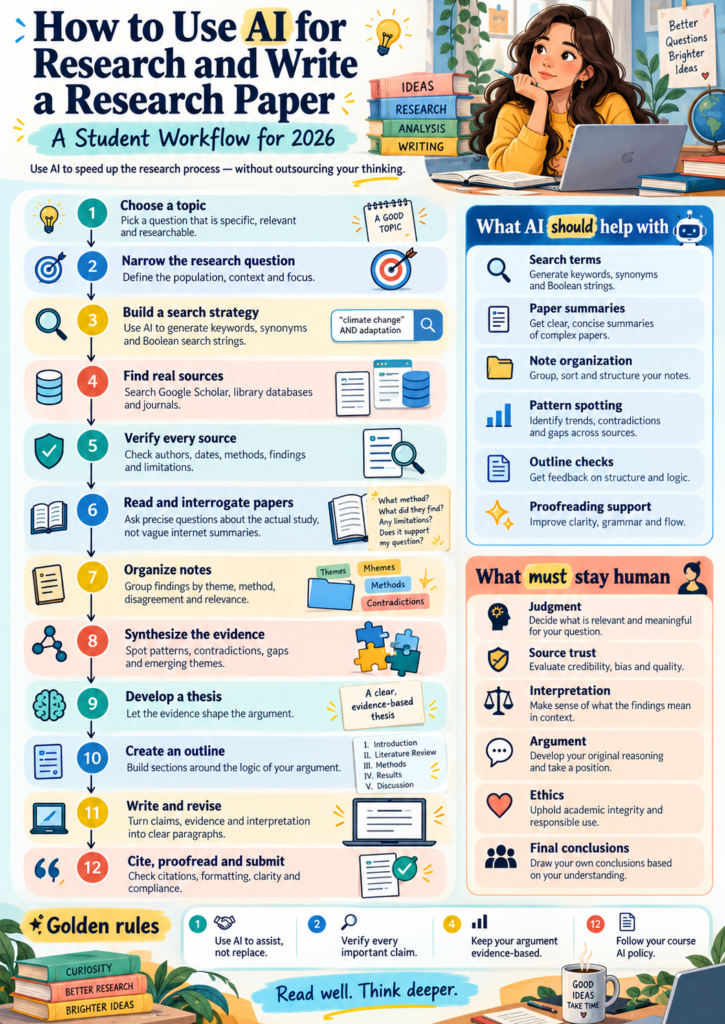
Four AI prompts that earn their place in the workflow
There is no need to turn research into a competition to see who can engineer the longest prompt. A few careful instructions, used at the right moment, are more valuable than one enormous prompt trying to conduct the entire project while you watch.
When your topic is still too large
I am developing a research paper on:

[TOPIC]

My assignment requirements are:

[REQUIREMENTS]

Help me explore six narrower research questions.

For each question:
- define the population or context;
- identify the central relationship or issue;
- explain what evidence would be needed;
- flag any assumption of causation;
- explain whether the scope may be too broad or too narrow.

Do not choose my research question for me.
Do not invent research findings or citations.
When you have a paper but need to understand it
Use only the research paper I have provided.

Identify:
- research question;
- methodology;
- sample or dataset;
- main findings;
- important limitations;
- claims the evidence supports;
- claims the evidence does not support.

For every point, identify the relevant page or section.

If the information is not present, write:
"Not stated in this source."

Do not add outside information.
When your notes have become a pile
I will provide notes from sources I have already verified.

Use only those notes.

Identify:
- recurring themes;
- areas of agreement;
- areas of disagreement;
- methodological differences;
- evidence gaps;
- claims supported by several sources;
- claims supported only weakly.

Do not decide my thesis.

At the end, ask me five questions that would help me decide what argument
the evidence supports.
When the draft exists and you need a second pair of eyes
I will provide:
1. My research question
2. My assignment requirements or rubric
3. My draft

Do not rewrite the paper.

Review whether:
- the research question is fully answered;
- the thesis matches the evidence;
- paragraphs contain analysis rather than only summary;
- important claims are supported;
- major limitations or competing interpretations are addressed;
- sections repeat one another;
- the conclusion follows from the argument.

Return:
1. Strongly covered
2. Needs attention
3. Evidence gaps
4. Questions I should answer
5. Final revision priorities

Do not invent sources or facts.
The recurring instruction “do not decide this for me” s not a weakness in the prompt.
It is the point of the education.
The final test is surprisingly simple
Imagine your professor closes the paper and asks you to explain it without looking at the screen.
- Why did you choose this question?
- Why did you trust this study more than that one?
- What is the most important limitation in your evidence?
- Which source changed your thinking?
- Why does your thesis say associated with instead of caused by?
- What would you research next if someone gave you another semester and an unreasonable amount of funding?
If you can answer those questions, AI probably helped you conduct the research.
If you find yourself thinking, I assume the chatbot had a reason, something important has gone missing.
A research paper should leave behind more than pages.
It should leave behind a researcher who understands the question better than when they began.
Perhaps this really is a golden era for researchers
There is something extraordinary about the scale of what is becoming possible.
AI systems are helping researchers explore genomes, design candidate molecules, inspect scientific literature and analyze quantities of information that would once have demanded enormous teams or enormous amounts of time. Yet the same technology can hallucinate a citation, flatten an uncertain argument into false confidence or encourage everyone to investigate the same well-lit corners of knowledge. The power and the danger are, inconveniently, arriving together. Nature
That is why the most valuable research skill in 2026 may not be prompting.
It may be judgment.
Judgment means knowing when AI can genuinely save you three hours—and recognizing when those three hours contain the very thinking you should not skip. It means noticing the difference between a meaningful pattern and an attractive coincidence, between a source that deserves confidence and one that deserves suspicion, and between a conclusion supported by evidence and one that has simply travelled further than the evidence allows. Sometimes the most valuable result is also the inconvenient one: the finding that refuses to support the argument you arrived hoping to make.
AI can carry more information to the table than any student could reasonably gather alone.
But the table still needs someone sitting at it. And somewhere, perhaps, a student is researching a topic today only because a professor assigned it. It is one paper among millions, one question opened between lectures, one cursor blinking on an otherwise ordinary afternoon.
Maybe it ends there.
Maybe it becomes a thesis.
Maybe a profession.
Maybe a discovery.
Research has always contained that quiet possibility: you begin by looking for an answer and occasionally discover the direction of your life instead.
AI can make the search faster.
Curiosity still has to decide where to go.
One question before you go
Which part of writing a research paper changes you from “this is interesting” to “why did I choose this degree”: finding credible sources, reading dense papers, organizing notes, building the thesis, citations, or the blank first page?
Tell us in the comments. We may build the next Conch guide around the problem students are actually struggling with.
Read well. Think deeper.😊
Related Reading
- How to Calculate H Index
- How to Write an Informative Essay
- Technology Essay
- How to Write a Header for an Essay
- How to Write a Biography Essay
- How to Write a Reflection Paper
- How to Write an Encyclopedia Entry
- Speech Analysis Example
- What is a Good H Index
- Why Is My Essay Being Flagged as AI? 11 Reasons—and What to Do
- Humanized AI Writing Is More Than AI Detection
- How to Improve Academic English: A Practical Guide for International Students
- Intelligence Is Becoming Abundant. Human Potential Should Too.
- How to Understand an Assignment Prompt Before You Start Writing
Leave a Reply