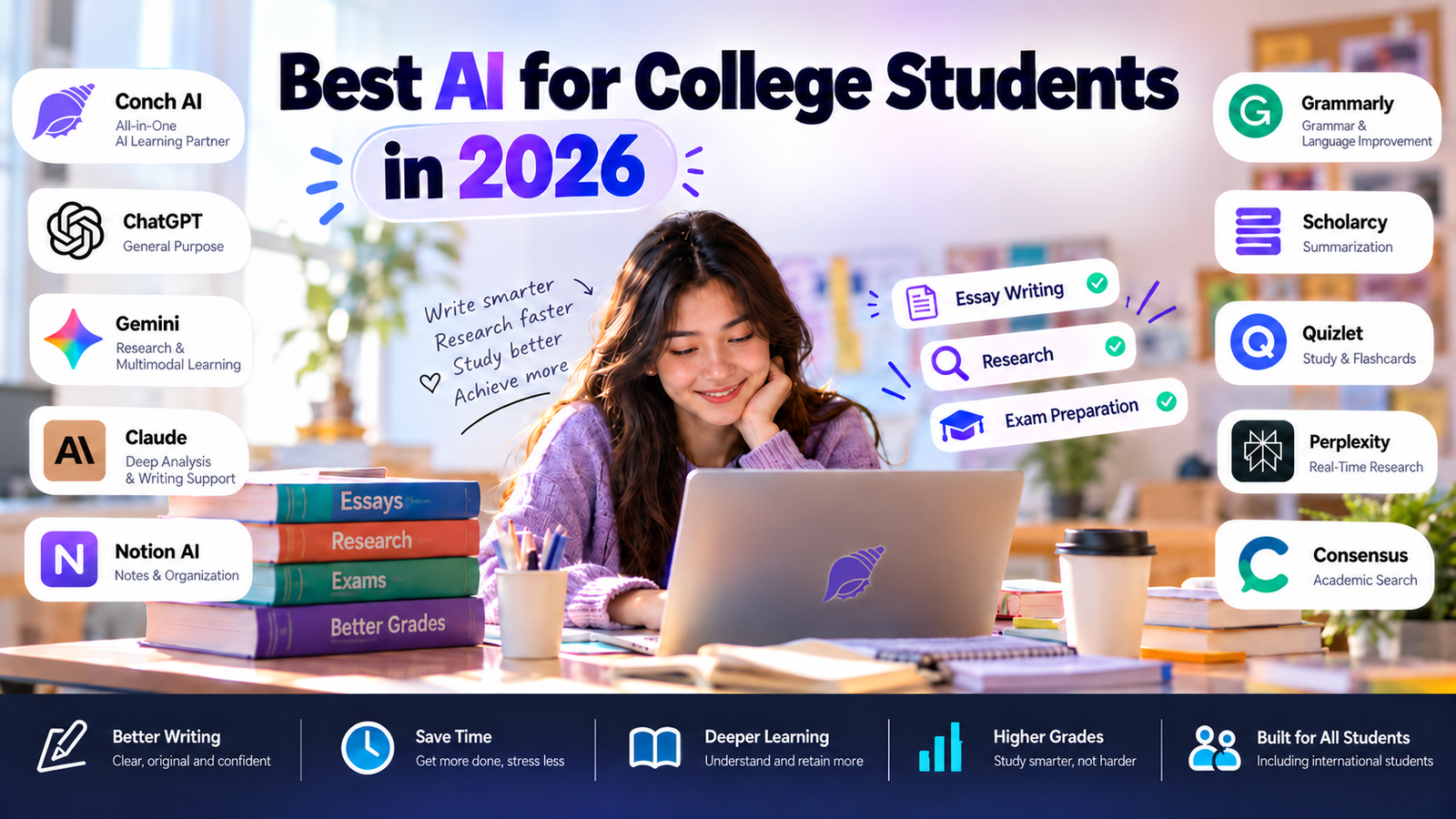
It’s 11:47 p.m. Your research paper is due tomorrow, you have seventeen browser tabs open, and your professor has somehow managed to make a 1,500-word essay feel like a doctoral dissertation. You decide to get some help from AI, only to discover that choosing the right AI tool has become an assignment of its own.
ChatGPT, Gemini, Claude, Perplexity, and dozens of specialized study assistants all promise to make college life easier. Some help you write, some help you research, and others turn lecture notes into flashcards, quizzes, or audio lessons.
But here’s the problem: Having more AI tools doesn’t necessarily mean you’re learning more or getting your work done faster.
The best AI for college students isn’t always the most popular or powerful tool. It’s the one that helps you solve your academic problems, makes difficult tasks manageable, and allows you to spend more time actually learning.
So, whether you’re an international student struggling to express your ideas in academic English, a research student sorting through endless academic papers, or someone who has an exam next week and absolutely no idea where to begin, this guide is for you.
We’ve compared nine AI tools based on what they actually offer, where they work best, their limitations, and their current prices. By the end, you’ll know which ones deserve a place in your study routine and which subscriptions you can probably live without.
Best AI Tools for College Students in 2026: Quick Comparison
If you’re looking for a quick answer, here’s how the nine tools compare.
| AI Tool | Best For | Pricing (USD) |
|---|---|---|
| Conch AI | All-in-one academic writing and learning partner | Free; 7-day pass $7.99; Plus $15/month; Unlimited from $15/month annually |
| ChatGPT | Concept explanations, tutoring, and problem-solving | Free; Go $8/month; Plus $20/month |
| Google Gemini | Guided learning and interactive studying | Free; Google AI Plus $9.99/month; Pro $19.99/month |
| Claude | Essay structure, reasoning, and writing feedback | Free; Pro $20/month or $200/year |
| Perplexity | Web research and discovering sources | Free; Education Pro $10/month for verified students |
| Gemini Notebook | Studying from PDFs, lectures, and research materials | Free; expanded access through Google AI plans |
| Grammarly | Grammar, clarity, and academic English | Free; Pro $30/month or $144/year |
| Elicit | Scholarly literature and research synthesis | Free; Plus from $11/month billed annually |
| Quizlet | Flashcards, practice tests, and exam revision | Free; Plus from $35.99/year |
Prices reflect publicly advertised US plans checked on October 20, 2026. Annual equivalents require an upfront annual payment. Regional pricing, taxes, promotions, eligibility, and usage limits may vary.
These tools aren’t ranked by AI intelligence or claimed testing scores. Each is recommended for a particular academic need, based on its documented capabilities.
1. Conch AI: Best All-in-One AI Learning Partner for College Students
Have you ever noticed how one college assignment quietly turns into six different responsibilities?
First, you need to understand the topic. Then comes the research, note-taking, organizing information, writing, editing, and somehow remembering everything when the exam arrives.
You could use one app for research, another for writing, a third for flashcards, and a fourth for planning. Of course, by the time you’ve finished organizing all these productivity tools, you may need another tool to manage your productivity.
That’s where Conch AI offers a practical alternative.
Conch AI is an all-in-one AI academic learning partner that brings writing assistance, humanized rewriting, AI-writing checks, research support, study tools, and audio learning together in one platform.
Rather than focusing on only one academic task, it helps students move through different stages of learning, from understanding difficult material to organizing knowledge and expressing their ideas clearly.
Write Better Academic English Without Losing Your Voice
Writing an essay is difficult enough when you understand the topic. It becomes more challenging when you also have to translate your thoughts into clear academic English.
Conch AI provides writing and rewriting assistance for essays and assignments. Its AI Humanizer and Rewrite Mode are designed to improve robotic or overly formal text by adjusting phrasing, sentence flow, clarity, and tone while aiming to preserve the original meaning and the writer’s voice.
Students can choose from nine writing styles, including Natural, Academic, Formal, Fluency, Simple, and Creative.
This can be particularly useful for international students who understand their subjects but struggle to communicate their ideas naturally in English.
For example, suppose you understand how climate policy affects developing countries, but your essay sounds awkward or unnecessarily complicated. You can use Conch to review the language, refine your sentences, and improve readability while making sure the argument remains yours.
Conch also includes AI-writing checks and feedback that can help you review patterns commonly associated with AI-generated writing. These checks are useful as diagnostic signals, but they cannot establish authorship or guarantee a particular result from Turnitin, GPTZero, or other detection systems.
The goal is to produce clearer, more natural, academically responsible writing while retaining control over your ideas.
Turn Your Study Material Into Multiple Learning Formats
Not everyone learns best by reading the same textbook chapter repeatedly. Some students prefer diagrams, others benefit from practice questions, while some find audio explanations easier to revisit.
Conch AI’s Study Suite brings these formats together.
Upload permitted course materials, lecture notes, or PDFs, and Conch can help you create organized notes, flashcards, quizzes, and mind maps. Its document-chat feature lets you ask questions about your material, while the Study Planner helps you organize revision sessions and deadlines.
Imagine you’re preparing for a psychology exam. You can simplify a difficult chapter, organize the theories into a mind map, create flashcards to check what you remember, and use the planner to spread your revision across the week.
Instead of studying in one format and hoping everything stays in your memory, you can revisit the same material in several useful ways.
Turn Notes Into Audio Learning With AI Podcasts
Conch also offers an AI Podcast Generator that converts documents and notes into narrated audio conversations.
You can customize the voices, hosts, episode length, and presentation style. Generated episodes include transcripts and chapter navigation, allowing you to listen and follow the material more easily.
For students who commute, prefer audio explanations, or want another way to review course material, this is a useful option.
Think of it as giving your lecture notes a voice, although listening should complement active revision rather than replace it.
Beyond its main platform, Conch also provides 10 free standalone writing and study utilities, including a Sentence Burstiness Analyzer, AI Phrase Detector, Citation Generator, Essay Outline Generator, and Readability Score Checker. These can be explored through its Free Tools Library.
Conch AI Pricing: Free, Assignment Pass, Plus, and Unlimited
One advantage of Conch’s pricing structure is that students can choose a plan according to their workload rather than committing to a large subscription immediately.
| Plan | Price | What You Get |
|---|---|---|
| Free | $0 | 500 writing-tool words, 3 flashcard sets, 3 mind maps, 2 podcasts, and 1 study plan per week |
| 7-Day Assignment Pass | $7.99 one-time | Unlimited tool usage for 7 days, all 9 writing styles, and no automatic renewal |
| Conch Plus | $15/month | 5,000 writing-tool words, 5 flashcard sets, 5 mind maps, 4 podcasts, and 3 study plans per week |
| Conch Unlimited | $25/month, or $15/month billed $180 yearly | Unlimited tool usage under the advertised plan, all writing styles, and priority support |
Students with an eligible .edu email address can also receive an advertised 10% discount on paid plans.
The seven-day Assignment Pass is particularly relevant when several deadlines fall within the same week. You get temporary access to the full toolset without taking on another recurring subscription.
For students who consistently need writing, studying, and revision support throughout the semester, Plus and Unlimited offer higher usage allowances.
Why students may prefer it: Conch connects humanized academic writing, study preparation, mind maps, flashcards, quizzes, AI podcasts, and planning tools in one academic workspace.
What to consider: It isn’t a replacement for specialist academic research databases. Students must still verify information, preserve their own reasoning, and follow university AI policies.
Best for: College students, particularly international students, who want one AI learning partner across writing, learning, revision, and exam preparation.
Explore Conch AI for Free: Study Smarter, Write Better, and Submit With Confidence.
2. ChatGPT: Best for Understanding Difficult Concepts and Guided Learning
Sometimes you don’t need another textbook explanation. You need someone to explain the same concept in a way that finally makes sense.
For instance, your economics professor might explain price elasticity through an elaborate series of graphs, while you’re still wondering why a small change in price can affect demand so dramatically.
ChatGPT can help break down complex subjects using examples, comparisons, and guided discussions.
Its Study Mode is particularly useful because it can guide students through problems step by step, ask questions, and check understanding instead of immediately revealing the final answer.
You might ask:
“Explain price elasticity using a college coffee shop as an example. Then give me three practice questions, one at a time, and let me answer before explaining the solution.”
This keeps you involved in the learning process rather than simply collecting answers.
ChatGPT is also helpful for planning essays, understanding mathematical concepts, debugging code, reviewing arguments, and generating practice questions.
Pricing: Free access is available. In the US, ChatGPT Go is advertised at $8/month and Plus at $20/month. Free usage and advanced features are subject to plan limits.
Why choose it: Flexible assistance across almost any subject, particularly for explanations and interactive tutoring.
Limitation: ChatGPT can still make factual, mathematical, or citation errors. Always verify important academic information.
Best for: Students who need a versatile AI tutor for concept explanations, problem-solving, and guided learning.
3. Google Gemini: Best for Interactive Learning and Personalized Study
Understanding a concept while reading an explanation is one thing. Being able to solve a similar problem independently is another.
That’s why guided learning can be more valuable than simply receiving a polished answer.
Google Gemini offers Guided Learning, which uses questions, explanations, and interactive material to help students work through concepts.
Google has also introduced study notebooks in Gemini that can create personalized learning activities from uploaded materials and student goals. These features can include diagnostic quizzes and study lessons that respond to identified knowledge gaps.
For example, a biology student preparing for a genetics exam could upload course notes, identify weaker topics through questions, and focus on concepts that need more attention.
Gemini also supports visual explanations, making it useful for subjects where diagrams and processes matter.
Pricing: Free access is available. US Google AI Plus is advertised at $9.99/month, while Google AI Pro costs $19.99/month and provides higher usage allowances and additional features.
Why choose it: Interactive learning, personalized explanations, and useful integration with Google’s ecosystem.
Limitation: Features and usage limits vary across Google plans, and generated explanations still require verification.
Best for: Students who prefer visual explanations, guided study sessions, and interactive practice.
4. Claude: Best for Essay Structure, Critical Thinking, and Writing Feedback
A well-written essay isn’t simply a collection of grammatically correct sentences.
You can use sophisticated vocabulary, write beautiful introductions, and still end up with an argument that doesn’t quite make sense. Unfortunately, your professor is grading your reasoning, not your ability to impress the dictionary.
Claude can be especially useful when you need thoughtful feedback on a draft.
For example, suppose you’re writing a sociology essay about social media and loneliness. After developing your own argument, you can ask Claude to identify weak assumptions, unclear transitions, unsupported claims, and potential counterarguments.
Try this prompt:
“Review my essay as a university writing tutor. Identify the three weakest parts of my argument and explain how I can improve them. Don’t rewrite the essay for me.”
This approach encourages you to strengthen your reasoning rather than outsource it.
Anthropic also provides a learning mode through Claude for Education, although that institutional offering should not be confused with the standard individual subscription.
Pricing: Claude has a Free plan. Claude Pro costs $20/month, or $200/year when billed annually. Higher-capacity Max plans start at $100/month.
Why choose it: Useful for analyzing arguments, evaluating written structure, and developing clearer reasoning.
Limitation: AI feedback isn’t automatically correct. Your assignment requirements and evidence should guide final decisions.
Best for: Students writing argumentative essays, proposals, and assignments that require critical analysis.
5. Perplexity: Best for Finding Sources and Exploring Research Topics
Finding information online has never been easier. Determining whether that information deserves to appear in your research paper is where things become interesting.
Perplexity combines AI answers with web search and source links, making it useful when you’re exploring an unfamiliar subject.
Suppose you’re researching renewable energy policy in the United States. Rather than asking for a completed essay, you could ask Perplexity to identify major arguments, relevant government publications, and academic studies worth investigating.
From there, you can open the sources, evaluate their credibility, and decide which evidence genuinely supports your research question.
Perplexity also offers research and learning features through its premium plans, including an education-focused subscription for verified students.
Pricing: The Standard plan is free. Education Pro costs $10/month for eligible students and educators who complete verification.
Why choose it: Useful for finding sources, exploring competing perspectives, and beginning research efficiently.
Limitation: Citations aren’t automatically reliable simply because a link appears beside an AI-generated answer. Always read and verify the original source.
Best for: Students beginning research assignments or investigating unfamiliar academic topics.
6. Gemini Notebook (Formerly NotebookLM): Best for Studying From Your Own Sources
Have you ever finished reading a 40-page research paper and realized that the only thing you clearly remember is how long it took?
This is where working directly with source material can make studying more manageable.
Google renamed NotebookLM to Gemini Notebook in July 2026. It remains a standalone research and learning product that helps users work with uploaded documents and other reference material.
Students can use it to ask questions about sources, create study guides, generate flashcards, and explore information through audio overviews.
Imagine uploading three research papers and your professor’s lecture slides about climate change. You could ask Gemini Notebook to compare their arguments, identify important disagreements, and explain unfamiliar terminology using the uploaded material.
This makes it especially useful when your assignment depends on specific readings rather than general knowledge.
Pricing: Gemini Notebook offers free access with limits. Expanded access is included in eligible Google AI plans, such as Google AI Pro at $19.99/month.
Why choose it: Source-centered learning and research organization, particularly when studying from several documents.
Limitation: Its answers depend partly on the quality and completeness of the materials you provide. Source-grounded answers can still contain mistakes.
Best for: Students working with lecture slides, lengthy PDFs, research articles, and course-specific reading material.
7. Grammarly: Best for Grammar, Clarity, and Academic English
Writing in your second language sometimes feels like doing the same assignment twice.
First, you need to understand the topic and develop an argument. Then you have to translate your understanding into grammatically correct, natural academic English.
And somewhere along the way, you may start believing that longer sentences and more complicated words automatically make your writing sound intelligent.
They don’t.
Grammarly helps students identify grammar mistakes, improve clarity, adjust tone, and revise awkward sentences.
For example, consider this sentence:
“The research is telling that students are having many difficulties because their study time is not organized.”
A clearer alternative would be:
“The research suggests that poor time management creates additional challenges for students.”
The second version is easier to understand, provided it accurately reflects what the research found.
Grammarly can help identify these opportunities for improvement, although students should review suggestions carefully to avoid changing the intended meaning.
Pricing: Grammarly Free costs $0. Grammarly Pro is advertised at $30/month, or $144/year, equivalent to $12/month when billed annually.
Why choose it: Convenient grammar and clarity feedback while drafting and editing academic work.
Limitation: Grammarly primarily addresses written communication. Students needing connected flashcards, study plans, or research-learning workflows may require additional tools.
Best for: International students and anyone who wants consistent feedback on academic English, grammar, and sentence clarity.
8. Elicit: Best for Academic Research and Literature Reviews
If you’ve ever worked on a university research project, you probably know that finding relevant academic papers is only half the challenge.
The other half is reading them, comparing their findings, evaluating their methods, and remembering which article contained the evidence you needed.
Elicit is designed specifically for scholarly research.
It helps researchers search academic literature, summarize papers, extract relevant information, and organize evidence across studies.
Suppose you’re writing a research paper about the relationship between sleep and academic performance. Elicit can help identify relevant studies and organize their findings, allowing you to compare research more systematically.
However, you still need to examine sample sizes, methodology, limitations, and whether the findings actually answer your question.
Pricing: Elicit Basic is free. Its Plus plan starts at $11/month when billed $132 annually. Its higher-capacity Pro plan starts at $39/month when billed $468 annually.
Why choose it: Focused academic literature discovery and evidence organization.
Limitation: More specialized and potentially more expensive than necessary for everyday coursework. It doesn’t replace critically reading the papers.
Best for: Graduate students, thesis writers, and undergraduates completing research-intensive assignments.
9. Quizlet: Best for Flashcards and Exam Preparation
There’s a particular kind of confidence that comes from rereading your highlighted notes before an exam.
Everything looks familiar, every sentence makes sense, and you begin to feel prepared. Then someone asks you to explain the concept without looking at the page.
Suddenly, that confidence becomes a little less convincing.
Quizlet helps students practice recalling information through flashcards, study activities, and AI-generated practice tests.
You can create flashcards from notes, review difficult terminology, and generate practice questions based on your study material.
For example, a nursing student could use Quizlet to memorize medical terminology, while a psychology student might create practice questions about theories, experiments, and important definitions.
Quizlet also offers AI study guides and tools for organizing uploaded notes and PDFs.
Pricing: Basic access is free. Quizlet Plus is advertised at $35.99/year, equivalent to approximately $2.99/month when billed annually. Quizlet Plus Unlimited costs $44.99/year, approximately $3.75/month when billed annually.
Why choose it: Focused exam practice, flashcard revision, and testing what you remember.
Limitation: Flashcards are valuable for recall, but complex academic subjects also require reasoning, explanation, and application.
Best for: Students preparing for exams involving definitions, terminology, factual recall, and repeated practice.
Which AI Tools Are Best for International Students Struggling With Academic English?
One of the most frustrating academic experiences is knowing exactly what you want to say but struggling to express it in the language your university expects.
This is particularly relevant for international students who may understand complicated concepts in their native language but need additional time to organize those ideas in academic English.
The challenge isn’t always a lack of knowledge. Sometimes, it’s the difference between understanding an idea and communicating it clearly.
That’s where AI writing support can be valuable.
Grammarly helps students improve grammar, clarity, and tone. ChatGPT and Claude can provide feedback on structure and argument development. Conch AI combines humanized rewriting and voice-preserving writing assistance with tools for understanding and organizing academic material.
A Better Way to Use AI for Academic English
Imagine you’re writing an environmental science essay about urban pollution. You have researched the topic, identified important evidence, and developed your argument, but the final sentences feel unnatural.
Instead of asking AI to write the entire essay, begin with your own ideas.
Write a paragraph in your most comfortable English, even if the grammar isn’t perfect. Then ask your chosen tool to improve clarity and academic flow without adding new arguments or changing the meaning.
Compare the revised paragraph with the original. Check the facts, identify the language improvements, and restore any phrasing that better reflects your perspective.
You can even ask the tool to explain why it changed specific sentences.
This turns AI-assisted editing into a learning opportunity rather than a simple copying exercise.
Good academic writing is about communicating your understanding clearly, not hiding your personality behind unnecessarily complicated vocabulary.
What About AI Detection and False Positives?
AI detection has become a concern for students, particularly those using language-assistance tools.
However, AI detectors are not perfect measures of authorship.
A peer-reviewed 2023 study published in Patterns found substantial misclassification of writing by non-native English speakers among the detectors evaluated. A systematic review published in Discover Education in October 2026 also discussed false positives and concerns about how linguistic patterns can affect detection results.
These findings don’t mean every detector behaves identically. They do show why a detection score should not automatically be treated as proof that a student used AI improperly.
Students should preserve research notes, original drafts, revision histories, and other evidence of their writing process. They should also understand what AI assistance their institution permits.
If you use Conch AI’s humanizer or writing checks, treat the output as feedback to review, not as a guarantee of any detection result.
How to Use AI Study Tools to Learn More Effectively
Generating a study guide in thirty seconds feels productive. But creating the material and learning it are two different things.
Research provides a useful distinction.
In a major 2013 review published in Psychological Science in the Public Interest, John Dunlosky and colleagues evaluated ten learning techniques. They identified practice testing and distributed practice as particularly useful across a range of learning situations.
Earlier research by Henry Roediger and Jeffrey Karpicke also demonstrated that retrieving previously studied information can improve long-term retention under the conditions they investigated.
So how do you connect these findings with AI study tools?
Test Your Memory Instead of Just Rereading
After studying a chapter, use Quizlet, Conch AI, or Gemini to create practice questions. Try answering from memory before looking at the explanation.
When you make a mistake, return to the original material and identify what you misunderstood.
Spread Revision Across Multiple Days
Instead of cramming an entire biology syllabus into one evening, revisit important topics across several sessions.
Use flashcards and quizzes to discover which concepts you remember and which need additional practice.
Make Your Study Sessions Specific
Rather than putting “study chemistry” on your schedule, try something measurable:
“Understand nucleophilic substitution, solve five related questions, and review incorrect answers.”
This makes it easier to begin the task and see whether you’ve made progress.
AI tools can reduce the effort required to prepare materials, but the learning still depends on how actively you engage with them.
For further reading, see Dunlosky et al. (2013) and Roediger and Karpicke (2006).
How to Choose the Right AI Tool Without Wasting Money
Before paying for an AI subscription, think about the problem you face most frequently.
If your biggest difficulty is understanding complicated subjects, begin with ChatGPT or Gemini. If you’re struggling to find scholarly evidence, explore Perplexity or Elicit. For grammar and writing clarity, Grammarly may be sufficient.
If exams are your priority, Quizlet and Gemini Notebook offer useful ways to work with revision material.
But if your coursework involves a combination of researching, reading, writing, organizing notes, improving academic English, and preparing for exams, an integrated tool like Conch AI may be a more convenient option.
The most sensible approach is to start with free plans, test the tools using a real academic task, and upgrade only when additional features or capacity solve a recurring problem.
For example, if you only need occasional grammar corrections, you probably don’t need an expensive research subscription. Similarly, if you have several assignments due within one week, a short-term plan such as Conch’s 7-Day Assignment Pass may be more appropriate than taking on a recurring monthly subscription.
And if one platform already covers most of your academic workflow, there’s little benefit in paying for several tools that largely duplicate one another.
Is It Okay to Use AI for College Assignments?
AI can help students understand difficult material, organize research, practice exam questions, and improve their writing. However, whether a particular use is permitted depends on the university, course, and assignment.
Before using AI for graded work, check your instructor’s requirements and institutional academic-integrity policy.
A responsible approach includes:
- Developing your own ideas, arguments, and conclusions.
- Checking AI-generated facts, quotations, and citations against original sources.
- Reviewing rewritten text to ensure it preserves your intended meaning.
- Protecting confidential research, personal information, and restricted educational records.
- Disclosing AI assistance whenever university rules require it.
In the United States, the Family Educational Rights and Privacy Act (FERPA) protects certain education records maintained by educational institutions. Students should also follow their institution’s data-handling rules before uploading course or personal information to third-party tools.
AI can support your academic work, but it shouldn’t replace your understanding, judgment, or responsibility for what you submit.
Frequently Asked Questions
What is the best AI for college students in 2026?
There isn’t one tool that’s best for every academic task. ChatGPT and Gemini are versatile learning assistants, Elicit is designed for academic research, Quizlet specializes in exam revision, and Conch AI combines academic writing assistance, study tools, and audio learning in one platform.
What are the best free AI tools for students?
ChatGPT, Gemini, Claude, Perplexity, Conch AI, Grammarly, Elicit, and Quizlet all offer free access to selected capabilities. Free usage limits and available features differ by provider.
Which AI tool is best for college essay writing?
Claude and ChatGPT are useful for outlining and evaluating arguments. Grammarly helps with grammar and clarity, while Conch AI provides academic writing and voice-preserving rewriting alongside study tools. The best choice depends on whether you need reasoning feedback, language improvement, or a connected learning workflow.
Which AI is best for academic research?
Elicit is particularly useful for scholarly literature searches and evidence organization. Perplexity helps students discover sources and investigate questions, while Gemini Notebook is useful for exploring uploaded research material. All sources and citations should be verified independently.
Can AI help international students improve academic English?
Yes. AI tools can help explain unfamiliar language, identify grammar mistakes, suggest clearer phrasing, and provide feedback on academic structure. Students should review suggestions and preserve their own meaning rather than accepting every revision automatically.
Can AI-generated flashcards help with exams?
Flashcards can support active recall, particularly when students answer from memory, review mistakes, and revisit material over time. However, successful exam preparation also requires understanding and applying concepts, not just memorizing definitions.
Is Conch AI free for college students?
Yes. Conch offers a free plan with weekly limits for writing tools, flashcards, mind maps, podcasts, and study planning. Students who need higher allowances can choose the 7-Day Assignment Pass, Plus, or Unlimited plans.
Is Conch AI better than ChatGPT for college students?
The tools serve overlapping but different purposes. ChatGPT is a general-purpose AI assistant with guided learning capabilities. Conch AI offers an integrated academic workspace combining humanized writing, writing checks, flashcards, mind maps, document chat, study planning, and podcasts. The better option depends on the student’s academic needs and preferred workflow.
Can AI humanizers guarantee that essays pass AI detection?
No. Humanizers can help improve natural phrasing, tone, and readability, but AI detectors are imperfect and no reliable tool can guarantee a specific classification across every detection service. Students remain responsible for following their university’s academic rules.
Final Thoughts: The Best AI Tool Is the One That Helps You Learn
College students have access to more information and learning technology than ever before. Yet information alone doesn’t guarantee understanding, and having a dozen AI subscriptions won’t magically make assignments disappear.
The real value of AI lies in making academic work more manageable, whether that means understanding a difficult concept, organizing scattered research, improving your writing, or preparing more effectively for exams.
Different tools solve different problems, so choose according to what you actually need.
If you’re looking for an AI learning partner that brings academic writing, humanized rewriting, research support, flashcards, mind maps, study planning, and audio learning into one workspace, Conch AI is worth exploring.
You can start with the free plan, discover which features suit your study routine, and upgrade when your academic workload calls for more.
Because the goal isn’t simply to finish your assignments faster. It’s to understand more, communicate better, and make your effort count.
Try Conch AI Free: Study Smarter, Write Better, and Submit With Confidence.
Sources and Editorial Disclosure
This article is published for Conch AI, one of the tools reviewed. The comparisons are based on providers’ published capabilities and prices, not independent head-to-head performance tests. Prices and features were reviewed on October 20, 2026.
Official product and pricing sources: Conch AI, ChatGPT, Google AI, Claude, Perplexity, Gemini Notebook, Grammarly, Elicit, and Quizlet.
Learning and academic integrity research: Dunlosky et al. (2013), Roediger and Karpicke (2006), Liang et al. (2023), Patterns, AI Detection Systematic Review (2026), and US Department of Education FERPA Guidance.
Related Reading
- How to Calculate H Index
- How to Write an Informative Essay
- Technology Essay
- How to Write a Header for an Essay
- How to Write a Biography Essay
- How to Write a Reflection Paper
- How to Write an Encyclopedia Entry
- Speech Analysis Example
- What is a Good H Index
- Why Is My Essay Being Flagged as AI? 11 Reasons—and What to Do
- Humanized AI Writing Is More Than AI Detection
- How to Improve Academic English: A Practical Guide for International Students
Leave a Reply