You have an exam tomorrow, 60 pages of lecture notes to revise, and an AI tool promising to turn them into flashcards in seconds. Sounds perfect, doesn’t it? You upload the PDF, click Generate, and congratulate yourself on finally finding a smarter way to study.
But what if that PDF also contains your student ID, a classmate’s grades, or information your professor never intended to be shared outside the university?
Suddenly, that convenient upload deserves a second thought.
As AI becomes part of everyday college life, students are using it to understand difficult subjects, organize research, improve academic writing, and prepare for exams. But while we’re getting better at writing prompts, there’s another skill we should develop: knowing what information is appropriate to share with AI.
That’s where FERPA guidelines come in.
FERPA, or the Family Educational Rights and Privacy Act, is a US federal law that protects certain student education records. It establishes important rules for educational institutions, but it doesn’t mean every academic document is legally protected under FERPA or that students are prohibited from using AI.
So, can you upload your lecture notes? What about an essay draft, group project, transcript, or research paper?
The answer depends on what you’re sharing, who has permission to share it, and how the AI service handles that information.
Here’s how to make those decisions without turning your next study session into a legal research project.
FERPA and AI: What Can Students Safely Upload?
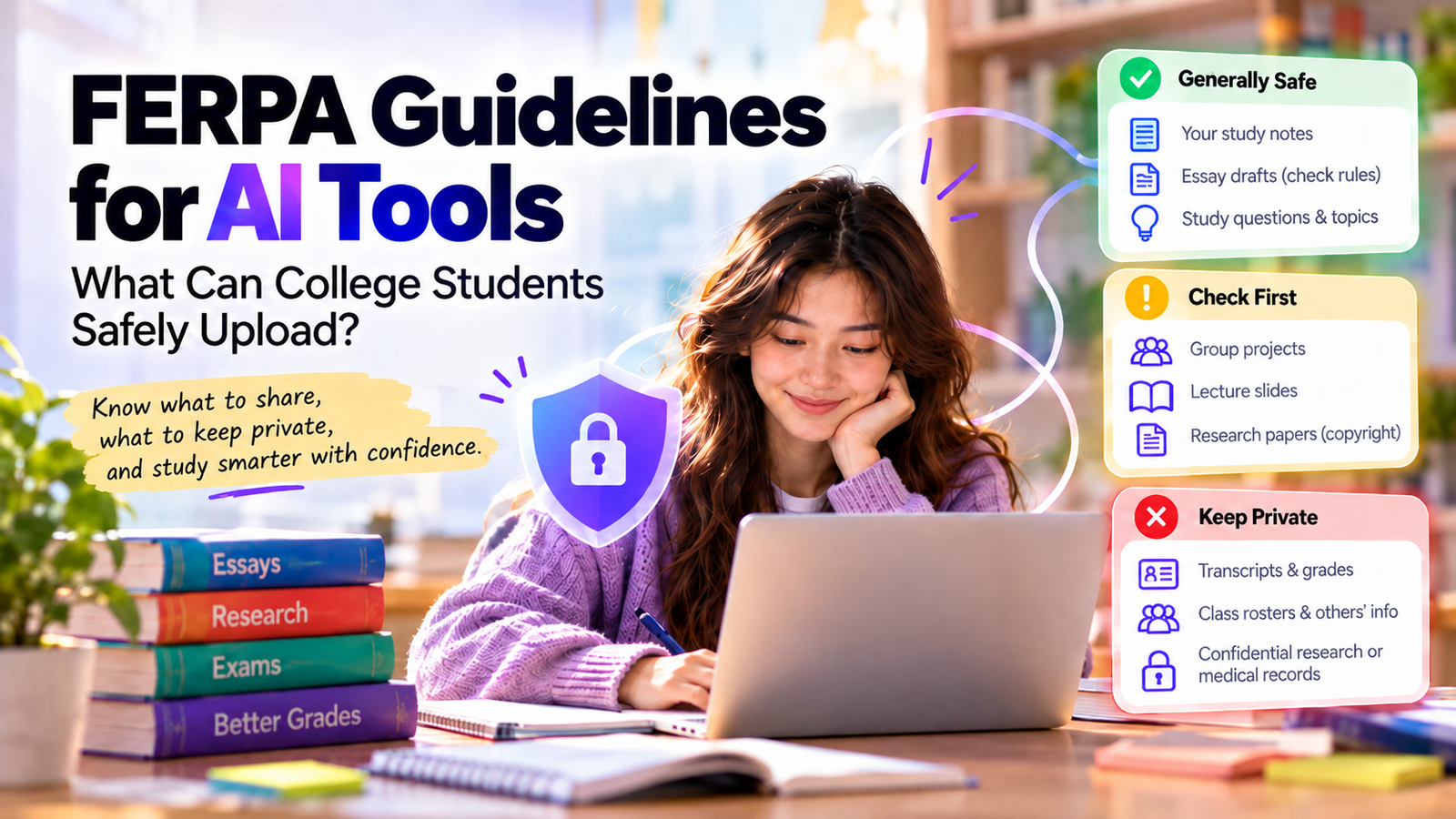
Quick answer: Students can generally use AI with their own non-sensitive study materials when their course rules permit it. However, documents containing other students’ personal information, confidential research, or restricted university records require extra care and may need specific authorization.
Here’s a practical guide:
| Document | Recommended action | Why it matters |
|---|---|---|
| Your own general study notes | Usually lower risk | Check for personal information or course restrictions |
| Your original essay draft | Check assignment policy | AI-assisted writing may be restricted |
| General study questions | Usually lower risk | Often no personal data is needed |
| Publicly available research papers | Check usage rights | Copyright and licensing may apply |
| Professor’s lecture slides | Check permission first | Course-sharing rules and copyright |
| Group assignments | Review before sharing | Teammates’ information and project restrictions |
| LMS screenshots | Avoid unedited uploads | May reveal IDs, grades, or private messages |
| Official transcripts and grade reports | Keep out of unapproved tools | Sensitive academic information |
| Class rosters and another student’s records | Do not upload to unapproved tools | Potential FERPA and privacy concerns |
| Confidential research or medical records | Obtain appropriate authorization | Research, confidentiality, or other legal obligations |
*These recommendations help students assess privacy risks. They aren’t blanket legal permissions or prohibitions, since the rules depend on the document and circumstances.
If you’re unsure about a file, begin with one question:
Does the AI really need all this information to help me?
In many cases, the answer is no.
What Is FERPA, and Why Does It Matter When Using AI?
The Family Educational Rights and Privacy Act (FERPA) was enacted in 1974 to protect certain education records maintained by schools and colleges covered by the law.
According to the US Department of Education, FERPA gives eligible students rights relating to accessing their education records, requesting amendments in certain circumstances, and controlling some disclosures of personally identifiable information.
These rights generally transfer from parents to students when they turn 18 or begin attending a postsecondary institution, regardless of age.
But here’s the distinction that matters most:
FERPA primarily regulates how covered educational institutions handle student education records. It doesn’t create a general ban on students using AI tools.
Imagine two situations.
In the first, a college student asks an AI assistant to explain the difference between mitosis and meiosis using their own general study notes.
In the second, a professor uploads a spreadsheet containing an entire class’s names, grades, and student numbers to an unapproved AI service.
Both involve education, but the privacy implications are very different.
The second situation may involve an institution disclosing personally identifiable information from protected education records, raising FERPA requirements. The first is an ordinary study activity that may be permissible, provided the material is appropriate to share and the student follows relevant course rules.
Understanding this difference makes FERPA much easier to apply in everyday college life.
What Counts as a Protected Education Record Under FERPA?
Not every document related to college automatically qualifies as an education record.
Under 34 CFR §99.3, education records generally have two characteristics:
- They are directly related to a student.
- They are maintained by an educational institution or a party acting on its behalf.
Examples include grades, transcripts, class lists, student course schedules, disciplinary files, and certain student financial records.
Now consider a notebook you’ve created for your own psychology revision. It isn’t automatically an institution-maintained education record simply because you’re enrolled in college.
However, a graded assignment maintained within your university’s learning management system may qualify as one.
This distinction is important because FERPA focuses on qualifying institutional records, not every piece of information a student creates.
What Is Personally Identifiable Information?
Personally identifiable information, often called PII, includes details that can identify someone directly or indirectly.
In FERPA education records, these details can include names, student numbers, addresses, family information, dates of birth, and other information that identifies a particular student.
And here’s something worth remembering: Removing someone’s name doesn’t necessarily make a document anonymous.
Suppose a research report describes the only international student in a small graduate program who received a particular disciplinary warning. Even without mentioning a name, someone familiar with the program might identify that person.
The Department of Education explains that information can identify someone through combinations of details, even when direct identifiers have been removed.
That means protecting privacy involves looking at the whole document, not just searching for names.
For more information, see the Department of Education’s guidance on personally identifiable information.
Can College Students Upload Their Own Essays and Assignments to AI Tools?
Generally, FERPA itself doesn’t impose a blanket restriction on students voluntarily sharing their own writing with an AI service.
However, an assignment may still be subject to course rules, confidentiality requirements, copyright restrictions, or the platform’s terms.
Let’s look at three situations students commonly face.
Scenario 1: You Want AI to Explain Your Lecture Notes
You’ve been studying cell biology for two hours, and mitosis and meiosis are beginning to sound suspiciously similar.
Instead of reading the same paragraph again, you want AI to explain the difference and create practice questions.
If you’re using your own non-sensitive notes and the course permits AI assistance, this is generally a lower-risk activity.
You might not even need to upload a document. You could simply ask:
“Explain mitosis and meiosis using a simple comparison, then give me five practice questions. Let me answer before showing the solutions.”
You get the learning support without sharing unnecessary information.
Scenario 2: You Want to Improve Your Academic English
You’re an international student working on a sociology essay. You’ve done the research, developed the argument, and understood the subject, but expressing everything naturally in academic English is taking longer than expected.
An AI writing assistant can help with grammar, clarity, and sentence structure.
For example:
“Review this paragraph for grammar and clarity. Explain your suggestions without introducing new arguments or changing my original meaning.”
This approach can help you improve your writing while learning from the feedback.
But check your instructor’s AI policy first. Some courses allow proofreading but restrict AI-generated rewriting.
Privacy rules and academic-integrity rules are different. Something can be appropriate to share from a privacy perspective while still being prohibited for a particular assignment.
Scenario 3: You Want AI to Analyze a Group Project
Your team has collected survey responses containing classmates’ email addresses, demographic information, and personal experiences.
Uploading the raw dataset to an unapproved AI service could expose information that participants or your university expected to remain confidential.
Instead, speak with your instructor or research supervisor. An institutionally approved system or properly authorized, de-identified dataset may be more appropriate.
Sometimes the smartest AI workflow begins before you upload anything.
Which College Documents Should You Keep Out of Unapproved AI Tools?
Some documents need additional protection, whether or not FERPA is the specific law that applies.
Official Transcripts, Grades, and Student IDs
These records often include personal information that an AI study tool doesn’t need.
If you’re calculating your GPA, for example, you can often provide anonymous grades and course credits rather than uploading your official transcript.
Other Students’ Personal Information
Having access to a class roster, group project, or discussion board doesn’t automatically mean you’re authorized to share its contents with a third-party service.
Take particular care with names, grades, student numbers, private messages, and identifiable personal circumstances.
Confidential Research Data
Research interviews, survey responses, participant records, and unpublished datasets may be subject to research ethics requirements, institutional agreements, or confidentiality restrictions.
If your project involves identifiable human participants, consult your research supervisor or Institutional Review Board (IRB) before using external AI services.
Medical and Counseling Information
Medical information deserves particular care. Depending on where and how records are maintained, FERPA, HIPAA, or other confidentiality obligations may be relevant.
Campus treatment records also have special treatment under FERPA regulations.
Avoid sharing identifiable medical or counseling information with an unapproved general-purpose AI service.
Copyrighted Lecture Materials and Textbooks
Privacy isn’t the only consideration when uploading academic material.
Lecture recordings, textbook chapters, and research publications may be protected by copyright or subject to license restrictions, even when they contain no personal information.
The US Copyright Office explains that fair use depends on several factors, including the purpose, nature, amount used, and potential market effect.
Educational use can be relevant, but it doesn’t automatically make every upload permissible.
When possible, use your own authorized summaries or ask questions about the topic instead of sharing an entire restricted document.
Is a University-Approved AI Tool Automatically FERPA Compliant?
Not for every possible use.
An AI provider may offer educational features, security controls, or special institutional accounts. But those qualities alone don’t establish that every type of student information can be shared with the service.
Under FERPA’s school-official exception, institutions may disclose protected education-record information to certain third-party service providers when specific regulatory conditions are met.
These include the provider performing an appropriate institutional function, operating under the institution’s direct control regarding the use and maintenance of records, and following restrictions on unauthorized use and redisclosure.
The Department of Education’s guidance on using online educational services explains these conditions.
For students, the important point is that approval may depend on the particular service, account, configuration, and type of information.
A university-managed AI account may have different contractual arrangements and privacy controls from a personal account with the same provider.
If your work involves restricted institutional information, check which service your university has authorized for that purpose.
Five Questions to Ask Before Uploading a Document to AI
You don’t need to become a privacy specialist every time you want to prepare for an exam. But a quick check can prevent unnecessary problems.
1. Do I Have Permission to Share It?
Check whether the material belongs to you, your instructor, another student, or a research organization, and whether its use is restricted.
2. Does It Contain Personal or Confidential Information?
Look for student IDs, grades, contact details, private messages, identifiable stories, financial records, and research-participant information.
Removing unnecessary identifiers can reduce risk, although proper de-identification sometimes requires more than deleting names.
3. Is This AI Service Appropriate for the Information?
Check your university’s approved technology guidance when institutional data is involved.
Also review the service’s privacy terms, including whether information may be retained, used to improve models, shared with processors, or deleted.
4. Can I Share Less Information?
Often, yes. If you want help understanding a formula, share the formula. If you’re preparing for an economics exam, provide the topics you need to revise.
You don’t need to share your student profile or complete academic history to generate a practice quiz.
5. Does My Assignment Allow This Kind of AI Assistance?
Finally, check your syllabus or instructor’s instructions.
Even when sharing a document presents little privacy risk, using AI to complete or rewrite assessed work may be restricted.
A useful habit: Check permission, check privacy, and share only what’s necessary.
How to Study With AI Without Uploading Sensitive Information
Most everyday study tasks can be completed without sharing highly personal information.
Imagine you’re preparing for a psychology exam. You want to understand classical conditioning, organize important theories, and practice remembering key definitions.
You could begin with your own general notes or a list of topics rather than uploading your entire course folder.
For students who prefer connected learning tools, Conch AI brings academic writing assistance, document simplification, flashcards, mind maps, study planning, and audio learning into one platform.
Its AI Study Sets can turn suitable study material into organized notes, editable flashcards, and a visual mind map.
For example, you could prepare a non-sensitive summary of classical conditioning and use the study suite to explore the concepts in different formats. You can then test your memory, identify areas that need revision, and return to the original material whenever an explanation needs checking.
Conch also offers a collection of free writing and study utilities, including tools for essay outlining, readability, and writing analysis.
As with any external AI platform, check the provider’s privacy policy and terms before sharing documents. Conch’s published terms currently specify that users must be at least 18 years old.
Conch is presented here as a learning option, not as a service independently certified or approved to process FERPA-protected institutional records.
Do FERPA Guidelines Apply to International Students?
Yes. International students attending US educational institutions covered by FERPA generally receive the applicable rights of eligible students, regardless of nationality.
FERPA rights depend on the student’s eligibility and the covered institution, rather than US citizenship.
For students studying outside the United States, other privacy laws may apply. For example, the EU General Data Protection Regulation (GDPR) and UK data protection rules govern certain personal-data processing activities within their respective legal scopes.
These laws are different from FERPA, and their application depends on the organization, location, and circumstances.
Whatever country you’re studying in, follow your institution’s data-sharing requirements and review the AI service’s privacy practices.
What Should You Do If You Accidentally Upload Sensitive Information?
Mistakes happen. Perhaps you uploaded an LMS screenshot before noticing a classmate’s grade in the corner, or shared a research file containing personal details.
Start by stopping further sharing.
Check the provider’s options for deleting the uploaded file or conversation. Remember that deleting something from the visible interface doesn’t necessarily establish that every stored copy has been removed immediately.
If the upload involved another student’s education records, restricted research information, or confidential university material, promptly contact your institution’s privacy, IT security, or research office and follow its reporting procedures.
For information belonging only to you, review the service’s privacy settings and contact its support team where appropriate.
The important thing is to respond according to what was shared and the relevant rules, rather than assuming every accidental upload has the same consequences.
Frequently Asked Questions About FERPA and AI
Does FERPA prohibit college students from using AI tools?
No. FERPA doesn’t create a general prohibition on students using AI. It primarily regulates how covered educational institutions handle protected education records. Course rules and institutional policies may still restrict particular uses.
Can I upload my own essay to an AI writing tool?
Potentially, yes, if your assignment permits the intended assistance and the document contains no information you’re restricted from sharing. Check the service’s privacy terms before uploading.
Can I upload lecture slides or textbook PDFs to AI?
That depends on course instructions, permissions, copyright, and licensing restrictions. Having access to a document doesn’t automatically authorize uploading it to an external service.
What information is protected under FERPA?
FERPA governs qualifying education records maintained by covered institutions or parties acting on their behalf. These can include grades, transcripts, disciplinary records, student schedules, and personally identifiable information contained in those records.
Is removing a student’s name enough to protect privacy?
Not always. IDs, email addresses, unusual circumstances, and combinations of details may still reveal someone’s identity.
Can a university use third-party AI tools with student records?
Yes, when the institution has an applicable lawful basis for disclosure and satisfies the relevant FERPA requirements. Authorization depends on the provider, intended use, applicable exception or consent, and institutional controls.
Does FERPA apply to international college students?
Generally, yes, for eligible students attending covered US institutions. Citizenship isn’t the deciding factor.
Can an AI tool guarantee FERPA compliance?
A blanket guarantee should not be assumed. Whether an institution’s particular use satisfies FERPA depends on the records involved, disclosure conditions, institutional arrangements, and relevant controls.
Final Thoughts: Study Smarter, Share More Carefully
AI can help students understand difficult concepts, improve academic English, organize research, and prepare for exams. Used thoughtfully, it can make college life more manageable.
But convenience shouldn’t mean sharing information without understanding where it goes.
The most important lesson from FERPA guidelines is that not all academic information carries the same privacy responsibilities. Your own study notes are different from university-maintained student records, and asking AI to explain a concept is different from sharing confidential information about someone else.
Before uploading a document, remember three questions: Do I have permission to share it? Does the AI need this information? And is the service appropriate for the task?
Those small decisions can help you make better use of technology while respecting academic rules and personal privacy.
If you’re looking for tools that support academic writing, organized notes, flashcards, mind maps, and audio learning, explore Conch AI using materials you’re authorized to share.
Because studying smarter isn’t just about getting answers faster. It’s about making thoughtful decisions along the way.
Study smarter, write better, and submit with confidence.
Sources and Further Reading
- US Department of Education: What Is FERPA?
- FERPA Regulations, 34 CFR Part 99
- What Is an Education Record?
- Personally Identifiable Information Under FERPA
- US Department of Education: De-identified Records
- School Officials and Third-Party Providers
- Using Online Educational Services Under FERPA
- US Copyright Office: Fair Use
- HHS: FERPA and HIPAA for Student Health Records
- Conch AI Privacy Policy
Last reviewed: October 23, 2026.
Related Reading
- Humanized AI Writing Is More Than AI Detection
- How to Improve Academic English: A Practical Guide for International Students
- https://www.getconch.ai/blogs/best-ai-for-college-students
- https://www.getconch.ai/blogs/how-to-remember-what-you-study
- https://www.getconch.ai/blogs/blogs-how-to-study-smarter
- https://www.getconch.ai/blogs/blogs-how-to-use-ai-for-research-paper
- https://www.getconch.ai/blogs/ai-and-human-potential
- https://www.getconch.ai/blogs/how-to-write-a-thesis-statement
- https://www.getconch.ai/blogs/ai-writing-tool-for-students
- https://www.getconch.ai/blogs/best-productivity-tools-for-students-2026
- https://www.getconch.ai/blogs/blogs-informative-essay-topics-for-college-students
- https://www.getconch.ai/blogs/blog-why-is-my-essay-being-flagged-as-ai
- https://www.getconch.ai/blogs/blogs-turn-lecture-notes-into-study-guide-with-ai-2
- https://www.getconch.ai/blogs/ai-for-students
- https://www.getconch.ai/blogs/humanized-ai-writing
Leave a Reply