
A practical guide to decoding what your assignment actually wants—before you disappear into twelve research tabs and discover you answered the wrong question.

Breaking an assignment into its task, scope, evidence, assessment criteria and submission rules can make research and writing much easier to plan.
TL;DR
Before you research an assignment, identify five things:
- Task: What are you actually being asked to do?
- Scope: Where does the question begin—and where should you stop?
- Evidence: What sources or material must support your answer?
- Assessment: What will your instructor actually evaluate?
- Rules: What must you submit, in what format, and by when?
Then rewrite the assignment in one sentence:
I need to [task] [subject], within [scope], using [evidence], while demonstrating [assessment criteria].
If that sentence is still fuzzy, your research probably will be too.
Later in this guide, you will also find ready-to-use AI prompts for:
- decoding an assignment brief;
- understanding difficult task words;
- turning a rubric into a checklist;
- building a research plan;
- checking whether your outline answers the question; and
- identifying questions to ask your instructor.
Because sometimes the problem is not writing the assignment.
It is figuring out what the assignment has been trying to say to you since Tuesday.
Sometimes the hardest part of an assignment is understanding the assignment
You know the scene. The assignment is open in one tab. Google Scholar is open in another.
There are seven papers you have not read, three you have somehow downloaded twice, and somewhere in the distance a deadline is quietly getting closer.
So you do what feels productive. You start researching.
Two hours later, you read the assignment again and notice three small words:
compare, evaluate, and recommend.
Tiny words.
Large consequences.
The assignment never asked you to explain the topic generally.
It asked you to compare two things, judge them using evidence, and then make a recommendation.
Your research might be excellent. Your notes might be organized. You may even have written an introduction you are emotionally attached to.
But you can still be answering the wrong question. It is the academic equivalent of boarding the correct train in the wrong direction. This is why one of the least glamorous study habits is also one of the most useful:
Understand the assignment before trying to impress the assignment.
University writing centers commonly recommend reading assignment prompts carefully before beginning, identifying important action words, source requirements, mechanics and the broader purpose of the task.
You usually do not need an hour to do this.
Ten focused minutes can save several unfocused ones later.
The five-part Assignment Prompt Map
Most complicated assignment briefs become much less intimidating when you stop treating them as one giant paragraph written in Lecturer.
Instead, break the brief into five layers:
| Layer | The question you are really asking |
|---|---|
| Task | What thinking am I expected to perform? |
| Scope | What belongs in the answer—and what does not? |
| Evidence | What am I expected to use to support my reasoning? |
| Assessment | What will the marker evaluate? |
| Rules | What exactly must I submit? |
Think of these as filters.
A paragraph can be clever and still be irrelevant.
A source can be credible and still be the wrong source for the assignment.
A beautifully written paper can still be incomplete if it answers two tasks and quietly forgets the third.
Your first job, then, is not to collect information.
It is to establish:
What would count as a complete and relevant answer to this assignment?
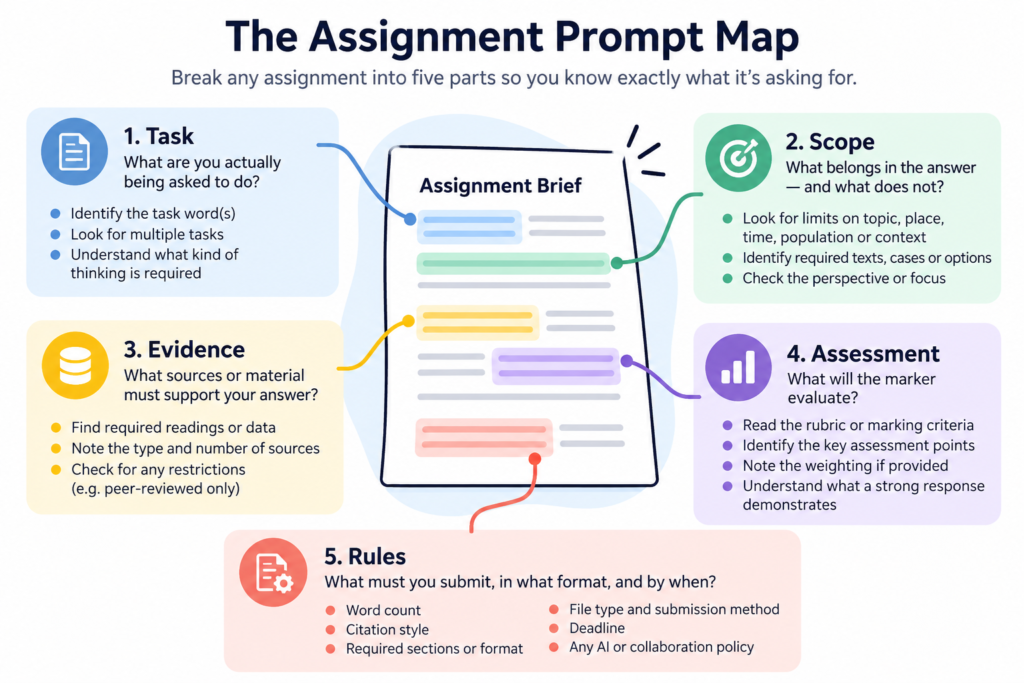
Highlight the task, scope, evidence, assessment criteria and submission rules before you begin researching.
Step 1: Find the task—not just the topic
Suppose your assignment is about:
Social media and mental health
That is a topic.
It is not yet a task.
You could be asked to:
- explain the relationship;
- compare two studies;
- evaluate a policy;
- analyze methodological limitations;
- critique an argument;
- recommend an intervention.
Same subject.
Very different paper.That is why task words matter. They tell you what you are expected to do with the information.
Common assignment task words
| If the prompt says… | Think… |
|---|---|
| Describe | What is it like? What are its important characteristics? |
| Explain | How or why does it happen? |
| Analyze | What relationships, causes, patterns or implications are present? |
| Compare | How are these things meaningfully similar or different? |
| Contrast | Where do they meaningfully differ? |
| Synthesize | What larger understanding emerges when these ideas or sources are brought together? |
| Discuss | What perspectives, evidence and arguments need to be examined? |
| Evaluate | How convincing, effective, useful or appropriate is it—and by what criteria? |
| Critique | What are its strengths, weaknesses, assumptions or limitations? |
| Argue | What position can I defend using evidence? |
| Justify | What evidence and reasoning support this decision? |
| Recommend | Given the evidence, what should happen next? |
These are working definitions, not universal laws.
Academic vocabulary has a charming habit of appearing standardized while changing slightly from department to department.
If your professor, discipline or course guide defines a term more specifically, use that definition.
One sentence can quietly contain three assignments
Consider:
Compare two interventions, evaluate their limitations, and recommend which should be prioritized.
That is not one job. It contains at least three:
Compare.
Evaluate.
Recommend.
Students often spend most of the essay lovingly comparing two options and then discover, somewhere around 1:17 a.m., that they still owe the reader an evaluation and recommendation.
The solution is wonderfully unglamorous: Turn every major instruction into a checkbox.
For example:
- Compare both interventions
- Evaluate their limitations
- Reach a recommendation
- Justify that recommendation using the previous analysis
If the prompt contains three intellectual jobs, your outline should show where all three happen.
Your essay cannot quietly resign from two of them.
Step 2: Find the scope, the art of knowing what not to write
Broad topics feel comfortable because almost everything seems relevant.
If your assignment is simply about “food waste,” you could research:
- restaurant waste;
- household behavior;
- climate change;
- supermarket supply chains;
- government policy;
- campus cafeterias;
- consumer psychology;
- agricultural systems;
- that documentary you watched six months ago.
And suddenly your research folder resembles a small government archive.
Scope saves you from this.
Compare:
Write about strategies for reducing food waste.
with:
Evaluate two strategies for reducing food waste in university dining halls in the United States.
The second question gives you boundaries.
University dining halls.
United States.
Two strategies.
Now the problem is smaller.
And smaller problems are usually easier to think about clearly.
Look for these scope limits
Ask:
Who?
Which population, group or organization?
Where?
Which country, institution, industry or setting?
When?
Which period?
What?
Which theories, texts, cases, policies or options?
How?
Which perspective, method or criteria?
For whom?
Is there a specific audience?
While researching, ask:
Does this source help me answer the exact question I was given?
Not:
Is this interesting?
Academia is full of interesting things you unfortunately do not have enough words to discuss.
That is part of the tragedy.
Step 3: Give every source a job
Students sometimes collect sources the way people collect snacks before a long journey:
More is probably better. Not necessarily. Five excellent journal articles do not automatically make a strong essay.
A better question is:
What will this source allow me to demonstrate?
Suppose you are comparing two approaches to reducing campus food waste.
Your evidence needs might look like this:
| Claim you may need to make | Evidence you would need |
|---|---|
| Approach A may be expensive | Cost or implementation evidence |
| Approach B may reduce waste more effectively | Outcome data or empirical research |
| One study may not transfer well to your campus | Contextual or methodological limitations |
| Approach A should be recommended | Evidence across your evaluation criteria |
Now research has a purpose. You are not simply collecting PDFs. You are assembling the evidence needed for an argument. That mental shift can save a ridiculous amount of time.
Required evidence and useful evidence are not the same thing
An assignment may explicitly require:
- prescribed course readings;
- primary documents;
- a particular dataset;
- a supplied case study;
- peer-reviewed research;
- lecture material;
- a minimum number of sources;
- a particular theoretical framework.
Separate those requirements from material you simply could use.
| Required by the assignment | Additional research |
|---|---|
| Two assigned readings | Recent journal articles |
| Supplied case study | Related case examples |
| Two peer-reviewed studies | Government or industry reports |
| Specified theoretical framework | Additional academic commentary |
If your professor asks you to use two course readings, five impressive external studies do not make those assigned readings optional.
The brief decides the rules. Your browser does not.
Step 4: Read the rubric before the night before
Rubrics have terrible marketing. Nobody opens an assignment and thinks:
Wonderful. A grading matrix.
But the rubric often tells you, quite plainly, what the instructor considers important enough to reward.
If critical analysis carries a large share of the marks, that is useful information before you write four pages of description.
If evidence carries heavy weight, you need to know where your strongest sources will do real work.
Turn rubric language into questions:
| Criterion | Ask while planning | Ask while revising |
|---|---|---|
| Argument | What am I ultimately trying to establish? | Is that position clear and supported? |
| Analysis | What relationships or implications must I explain? | Am I analyzing rather than summarizing? |
| Evidence | What will support each major claim? | Does each source actually support what I say? |
| Critical thinking | Where are the limits or competing explanations? | Have I acknowledged important uncertainty? |
| Organization | What order makes the reasoning easiest to follow? | Does every section have a clear purpose? |
| Referencing | Which system applies? | Are citations and references complete and consistent? |
One important distinction:
Your rubric is not automatically your table of contents.
If a rubric contains critical thinking, evidence and organization, please do not automatically create headings called:
Critical Thinking
Evidence
Organization
The question should shape the paper. The rubric helps you judge whether the paper is doing its job.
Step 5: Extract the boring rules before they become exciting problems
Finally, record the practical requirements.
For example:
| Requirement | Answer |
|---|---|
| Deliverable | Research essay |
| Word limit | 1,500 words |
| Citation style | APA 7 |
| Required sources | Two course readings + two peer-reviewed studies |
| Required sections | Not specified |
| File type | |
| Deadline | October 14 |
| AI policy | Check course guidance |
Do not rely on memory. Some of the easiest requirements to protect are also the easiest to overlook.
Pay attention to words such as:
must
should
may
They do not mean exactly the same thing.
And if two instructions genuinely conflict—say, one page asks for four sources while the rubric says six—do not perform academic telepathy.
Ask.
Worked example: from vague assignment to clear plan
Consider this fictional prompt:
In 1,500 words, compare and evaluate two approaches to reducing food waste on a university campus. Use the two assigned course readings and at least two additional peer-reviewed sources. Consider feasibility and environmental impact, then recommend one approach. Use APA 7th edition. Your work will be assessed on the quality of comparison, critical evaluation, use of evidence, justification of the recommendation, organization, and referencing.
A rushed interpretation might be:
Write 1,500 words about food waste.
The Prompt Map tells a different story.
| Layer | What the assignment actually requires |
|---|---|
| Task | Compare → evaluate → recommend |
| Scope | Two approaches → food waste → university campus |
| Evidence | Two assigned readings + two additional peer-reviewed sources |
| Assessment | Comparison, evaluation, evidence, recommendation, organization |
| Rules | 1,500 words + APA 7 |
The assignment did not become easier. It became clearer. And clarity is often what we mistake for intelligence.
The Assignment Prompt Toolkit: 5 AI prompts you can actually use
Understanding an assignment is one problem.
Knowing what to do next is another. So instead of giving you one enormous AI prompt that looks like it requires its own syllabus, here are smaller templates for different stages of the assignment.
Use only the one you need. Before using any AI tool with course materials, check your institution’s AI policy. Your university may have opinions. Universities tend to enjoy those.
Template 1: Decode the assignment
Use this when: You have just received the assignment and want to understand what it explicitly requires.
Copy and paste:
I will give you an academic assignment brief.

Help me understand the instructions without writing the assignment for me.

Identify:

1. What I have to submit
2. Every task I am being asked to perform
3. The topic or problem I need to address
4. The scope — including any limits on place, period, population, texts, cases or theories
5. Required sources or evidence
6. Assessment or rubric criteria
7. Word count, citation style, formatting and submission rules
8. Anything that is unclear or missing

For every requirement, quote or point to the wording in the brief that supports your answer.

Do not invent requirements that are not stated.

Finish by completing this sentence:

“My assignment asks me to [task] [subject], within [scope], using [evidence].”
What to do with the answer
Do not immediately start writing. Check the AI’s interpretation against the original brief. Then highlight anything it labels unclear. Those are the parts you may need to confirm with your instructor.
AI is useful here as a highlighter with opinions. It is considerably less useful as a telepath.
Template 2: Explain difficult task words
Use this when: You understand the topic but words such as analyze, evaluate, critique or discuss are making the assignment suspiciously vague.
My assignment contains these task words:

[PASTE TASK WORDS OR ASSIGNMENT QUESTION]

Explain what each task word requires in the context of this assignment.

For each one, show me:

- what kind of thinking it requires;
- what a weak response would do;
- what a stronger response would do;
- what evidence I may need;
- what my final paper should demonstrate.

Do not write the paper or choose my argument.

Put the answer in a table.
Example
Suppose your assignment says:
Compare two policies, evaluate their effectiveness, and recommend one.
Your output should help you distinguish between:
Compare → establish meaningful similarities and differences.
Evaluate → judge each policy using evidence and criteria.
Recommend → use that evaluation to justify a decision.
Those are three different jobs.
Your essay cannot complete one and hope the other two are impressed by the effort.
Template 3: Turn the rubric into a checklist
Use this when: You have a marking rubric and would prefer to understand it before it becomes a source of emotional damage after grading.
I will provide my assignment rubric.

Turn it into a practical checklist I can use while planning and revising.

For each criterion:

1. Explain what it explicitly assesses
2. Show its weighting if one is given
3. Give me one question to ask while planning
4. Give me one question to ask while writing
5. Give me one question to ask while revising
6. Identify common ways a student could fail to demonstrate this criterion

Do not invent expectations that are not in the rubric.

Do not automatically turn rubric categories into essay headings.
Then use the result twice:
Before drafting: as a planning checklist.
Before submitting: as a revision checklist.
This is much more useful than opening the rubric for the first time after writing 1,973 words and discovering that “critical evaluation” was apparently important.
Template 4: Turn the assignment into a research plan
Use this when: You understand the question but have no idea what to search for.
Here is my assignment:

[PASTE ASSIGNMENT]

Here is my understanding of it:

Task:
[INSERT]

Scope:
[INSERT]

Required evidence:
[INSERT]

Evaluation criteria:
[INSERT]

Help me build a research plan.

For each major requirement, identify:

- what I need to find out;
- what type of evidence could answer it;
- useful search concepts;
- 3 example academic search queries;
- evidence that would probably be too broad or irrelevant;
- important research gaps I should watch for.

Do not invent sources.

Do not decide my conclusion before I have reviewed the evidence.

Finish with a research matrix:

| Requirement | Evidence needed | Search terms | What I have | What is missing |
Why this is useful
Suppose your assignment asks you to evaluate two campus food-waste interventions using:
- feasibility;
- environmental impact.
Your research should not simply be:
food waste
It should become something closer to:
university food waste intervention feasibility study
or:
campus dining waste environmental impact peer reviewed
The assignment itself supplies part of your search strategy.
Convenient.
Almost suspiciously so.
Template 5: Check whether your outline actually answers the question
Use this when: You have researched the topic and created an outline, but you want to know whether you are drifting away from the assignment.
I will give you:

1. My assignment prompt
2. My planned outline

Compare the outline against the assignment.

Do not rewrite the essay.

For every section of my outline, tell me:

- which assignment requirement it addresses;
- whether it is directly relevant;
- whether I am describing, analyzing, comparing, evaluating or recommending;
- whether any required task is missing;
- whether any section appears unnecessary or outside the scope;
- what evidence that section still needs.

Then give me:

1. Missing requirements
2. Possible repetition
3. Sections that may be too broad
4. The three biggest gaps I should fix before drafting
This is particularly useful because research has a strange habit of making every interesting fact look essential.
It is not.
Some facts are simply very attractive distractions.
Bonus prompt: What should I ask my instructor?
Sometimes you know the assignment is unclear.
You just do not know how to phrase the question without sounding as though you opened the brief four seconds ago.
Use:
I will provide an assignment brief.

Identify only the instructions that are genuinely ambiguous, contradictory or incomplete.

For each issue:

1. Show the relevant wording
2. Explain why more than one interpretation is possible
3. Explain how the ambiguity could affect my work
4. Draft one concise question I could ask my instructor

Do not resolve the ambiguity yourself.

Do not guess what the instructor probably intended.
Instead of emailing:
“I don’t understand the assignment.”
you can ask something specific:
“The brief asks us to evaluate two approaches using the assigned case study. Should both approaches come from that case, or may one come from the additional literature?”
That is easier for your instructor to answer. It also quietly communicates:
I did read the assignment.
A surprisingly useful message to send.
The 60-second version
Do not want to use one of the longer templates?
Use this:
Help me understand this assignment before I start researching.

Tell me:

1. What do I have to produce?
2. What are all the tasks?
3. What is the exact scope?
4. What evidence is required?
5. What will be graded?
6. What rules must I follow?
7. What is genuinely unclear?
8. What should I do next?

Only use information stated in the assignment.

Do not write the assignment for me.
Then verify the answer against the original brief. That last step matters. The goal is not to outsource your understanding.
The goal is to make the instructions easier to inspect.
Use AI in stages, not all at once
A useful workflow is:
Decode → Verify → Clarify → Research → Outline → Check
1. Decode
Work out what the assignment explicitly asks for.
2. Verify
Check those requirements against the original brief.
3. Clarify
Ask your instructor about genuine ambiguity.
4. Research
Search specifically for the evidence your assignment needs.
5. Outline
Create a structure that visibly completes the required tasks.
6. Check
Compare the outline with the prompt and rubric before drafting.
Notice what is missing from that workflow:
Ask AI to write my paper → hope for spiritual peace
There is a reason.
AI can reduce administrative friction. It can help you organize requirements, identify gaps, build search terms and test whether your plan matches the brief.
But the academic work still belongs to you:
- interpreting evidence;
- deciding what matters;
- developing the argument;
- evaluating competing explanations; and
- reaching the final judgment.
That is not the annoying part we are trying to automate away.
That is the part your assignment is actually assessing.
Let the prompt change the way you research
This is the step many students miss.
A decoded assignment should change your search strategy.
Searching:
food waste
is technically relevant.
It is also the research equivalent of shouting your question into a stadium.
Your assignment already gives you better search language.
A useful formula is:
Topic + Context + Criterion + Evidence Type
Instead of:
food waste
try:
university campus food waste intervention feasibility
or:
campus food waste environmental impact peer reviewed
or:
university dining food waste intervention evaluation
Now the prompt is not merely telling you what to write.
It is telling you what evidence to look for.
Build a research matrix before your tabs become sentient
If you are comparing two approaches, create a simple table while researching:
| Criterion | Approach A | Approach B |
|---|---|---|
| Feasibility | Evidence + limitation | Evidence + limitation |
| Environmental impact | Evidence + limitation | Evidence + limitation |
| Context fit | Evidence + limitation | Evidence + limitation |
| Overall implication | What does this suggest? | What does this suggest? |
The table shows you what you know.
More importantly, it exposes what you do not know.
Maybe you have five papers showing that Approach A has environmental benefits but nothing about whether a university can realistically implement it.
Excellent.
Now you know what to search for. Research becomes less like wandering and more like filling specific gaps.
Your outline should reveal your reasoning
For the same assignment, you might structure the paper like this:
Introduction
Define the problem, identify the two approaches and establish your criteria.
Feasibility
Compare both approaches using the same practical considerations.
Environmental impact
Compare the available evidence for each approach.
Evidence quality and limitations
Discuss uncertainty, conflicting findings or limits in applicability.
Recommendation
Use the previous analysis to justify your decision.
Conclusion
Bring the reasoning together without discovering three new arguments in the final paragraph.
Notice that this differs from:
Approach A
Approach B
Conclusion
That structure can easily create two separate mini-essays.
A criterion-based structure keeps bringing the options into conversation with one another. Your outline should not merely store information. It should show the movement of your thought.
The same method works outside social science
Consider a literature assignment:
Analyze how narrative perspective shapes the reader’s understanding of responsibility in two assigned short stories. Refer closely to both texts and develop a comparative argument.
The topic is not simply:
narrative perspective
The assignment is asking for much more.
Analyze means you need to explain an effect.
Responsibility gives you a conceptual focus.
Two assigned stories means both texts are compulsory.
Refer closely means textual evidence matters.
Comparative argument means the stories eventually need to speak to each other rather than live in separate apartments.
Different discipline, Same method. That is why understanding the logic of a prompt is more useful than memorizing one universal essay template.
What about “to what extent”?
Not every assignment politely gives you an obvious task verb.
Consider:
To what extent did social media contribute to changes in political participation among university students between 2015 and 2025?
The hidden task is judgment.
You need to decide how much social media contributed. That probably requires you to:
- establish the relevant changes;
- examine evidence for social media’s role;
- consider alternative explanations;
- weigh limitations;
- reach a qualified conclusion.
So do not hunt only for verbs.
Ask:
What decision is this question forcing me to make?
Sometimes that is where the real assignment is hiding.
What does “critically evaluate” actually mean?
“Critically evaluate” generally requires more than describing strengths and weaknesses.
A stronger response usually needs to:
- establish relevant criteria;
- examine supporting evidence;
- consider strengths and limitations;
- address competing evidence or interpretations; and
- reach a reasoned judgment.
For example, if you are critically evaluating an educational intervention, you might consider:
- effectiveness;
- evidence quality;
- cost;
- applicability;
- limitations;
- unintended effects;
- alternative approaches.
The important part is that the judgment emerges from your evidence.
Not from:
“Personally, I just feel Approach B is better.”
Your feelings are welcome in many areas of life.
Academic evaluation generally asks them to bring citations.
What if the assignment is genuinely unclear?
Sometimes the problem is not you. The instructions are unclear. It happens.
Maybe the prompt says four sources and the rubric says six.
Maybe the brief asks you to use “the case” without making it obvious whether you can introduce another.
Maybe the word count appears to have developed two separate personalities. Do not spend three hours trying to infer your professor’s inner thoughts.
Ask, But precisely.
Instead of:
“I don’t understand the assignment.”
try:
“The brief asks us to evaluate two approaches using the assigned readings and additional research. Should both approaches come from the provided case, or may one come from the additional literature?”
That is easier for an instructor to answer.
It also demonstrates that you have already done some thinking—which lecturers generally appreciate because they, too, are human beings with inboxes.
Copy this assignment-breakdown worksheet
Before you begin serious research, complete this:
| Question | Your answer |
|---|---|
| What exactly am I submitting? | |
| What is the central question? | |
| What are all the required tasks? | |
| What topics, texts, cases or options must I cover? | |
| What population, location, period or context limits the answer? | |
| Who is the audience, if specified? | |
| Which evidence is compulsory? | |
| Which additional evidence is permitted? | |
| Are any sources restricted or prohibited? | |
| Which criteria must I use to compare or evaluate? | |
| What does the rubric reward most? | |
| What conclusion, judgment or output must I produce? | |
| What is the word limit? | |
| Which citation style applies? | |
| What is the deadline? | |
| What does the course say about AI use? | |
| What still needs clarification? |
Then complete two sentences:
My assignment asks me to [task] [subject], within [scope], using [evidence]. My answer needs to demonstrate [assessment criteria].
And:
The most important evidence I still need to find is [research gap].
Those two lines give you something surprisingly valuable.
Direction.
And direction is often what students are really missing when they say:
“I don’t know how to start.”
Sometimes you know perfectly well how to write.
You just do not yet know what you are writing toward.
The three-minute check before you start drafting
Before you leave research mode, ask yourself:
1. Coverage
Can I point to where every major task will be completed?
2. Relevance
Does every planned section help answer the actual question?
3. Evidence
Do my important claims have appropriate support?
4. Reasoning
Does my structure move toward the judgment or conclusion the assignment requires?
5. Compliance
Have I accounted for:
- the rubric;
- word limit;
- citation style;
- source requirements;
- formatting;
- submission rules; and
- AI policy?
If one answer is no, fix it now.
Outlines are cheap to change.
Finished paragraphs are emotionally expensive.
Frequently asked questions
What is an assignment prompt?
An assignment prompt is the set of instructions explaining what you are expected to produce and demonstrate.
It may include:
- the topic;
- task words;
- scope;
- evidence requirements;
- assessment criteria;
- word count;
- citation rules;
- formatting requirements; and
- submission instructions.
It may also be called an assignment brief, assessment brief, essay prompt, task sheet or assignment question.
What is the difference between the topic and the task?
The topic tells you what the assignment concerns.
The task tells you what you need to do with it.
“Artificial intelligence in education” is a topic.
“Evaluate two uses of artificial intelligence in higher education and argue which creates greater educational value” is a task.
One gives you a subject. The other gives your thinking a direction.
What are task words in an assignment?
Task words are instructions such as:
- analyze;
- compare;
- discuss;
- explain;
- evaluate;
- critique;
- justify; and
- recommend.
They indicate what type of intellectual work your response should demonstrate.
How do you break down an assignment question?
Start by identifying:
- the task;
- the subject;
- the scope;
- the evidence requirements;
- the assessment criteria; and
- the practical submission rules.
Then rewrite the assignment in one sentence so you can see exactly what the final response needs to accomplish.
How many times should I read an assignment prompt?
Reading it at least twice is a useful starting point:
- once for the overall purpose;
- once to identify tasks, scope, evidence and rules.
For more complicated assignments, you will probably return to the brief several times while researching, outlining and revising.
That is not overthinking.
It is usually cheaper than rewriting half the paper later.
What does “analyze” mean in an assignment?
Analyze generally means examining a subject in parts so that you can explain important relationships, causes, patterns, effects or implications.
It normally requires more than description or summary.
What does “critically evaluate” mean?
It generally requires you to use relevant criteria and evidence to assess strengths, weaknesses, limitations and competing interpretations before reaching a reasoned judgment.
In other words:
Do not just tell the reader what exists.
Explain what you make of it—and why.
What does “to what extent” mean?
“To what extent” usually asks you to make a judgment about degree.
A strong answer rarely ends with a simple yes or no.
You normally need to weigh supporting evidence, limitations and alternative explanations before reaching a qualified conclusion.
Can one assignment contain several tasks?
Absolutely.
A single prompt may require you to compare, analyze, evaluate and recommend.
That is why identifying every major task early matters.
Should the rubric become my essay outline?
Not automatically.
The rubric tells you how your work will be assessed.
Your research question, argument and reasoning should usually determine the structure.
Use the rubric to evaluate the quality of that structure rather than treating every criterion as a section heading.
Can AI help me understand an assignment?
Yes—especially for extracting, categorizing and organizing explicit requirements.
AI can also help you:
- identify task words;
- organize rubric criteria;
- generate search concepts;
- spot possible ambiguity;
- create research matrices; and
- check whether an outline still matches the brief.
But AI should not be treated as the final authority on ambiguous instructor expectations.
Verify its interpretation against the original document, follow your institution’s AI policy, and ask your instructor when an ambiguity affects an important decision.
Understand first. Research second. Write third.
Most assignment problems do not begin with a badly written sentence.
They begin much earlier.
The question was misunderstood.
The research became too broad.
Sources were collected without a clear purpose.
The outline grew in five different directions.
And somewhere close to the deadline comes the slightly terrifying thought:
Wait. Am I actually answering the question?
There is a better sequence:
Understand → Verify → Research → Organize → Write → Revise
Simple does not mean easy.
But simple is easier to follow.
An assignment brief is not only a collection of restrictions standing between you and a grade.
Read carefully enough and it becomes a map.
It tells you:
- where to look;
- what to ignore;
- which evidence matters;
- what kind of thinking is expected; and
- where your argument eventually needs to arrive.
If your course permits AI use, a document-chat tool can help organize the explicit requirements in your assignment brief and make the administrative part less foggy.
But keep the important part—the interpretation, evidence, curiosity, judgment and final decision—yours.
That is not the tedious part of academic work.
That is the academic work.
Related reading
- Essay on Respect
- Essay About Bullying
- Why I Deserve This Scholarship Essay
- Is Census Data Primary or Secondary
- Is a Documentary a Primary Source
- Are Textbooks Primary Sources
- Essay About Death
- How to Write a 4 Paragraph Essay
- Finance Research Paper Writing
Leave a Reply