There are nights when studying begins as an academic activity and slowly becomes a test of endurance. The books spread across the table, one coffee mug becomes two or three, and the chapter glows under so much yellow highlighter that the few untouched sentences begin to look suspiciously important. You promised yourself you would sleep at one. Sometime around three, the birds begin chirping outside, and you realize with some disappointment that the night has quietly become morning.
You have worked. You have read, written, highlighted and reread. Yet one uncomfortable question remains: will your brain be able to find all of this again when the book is closed?
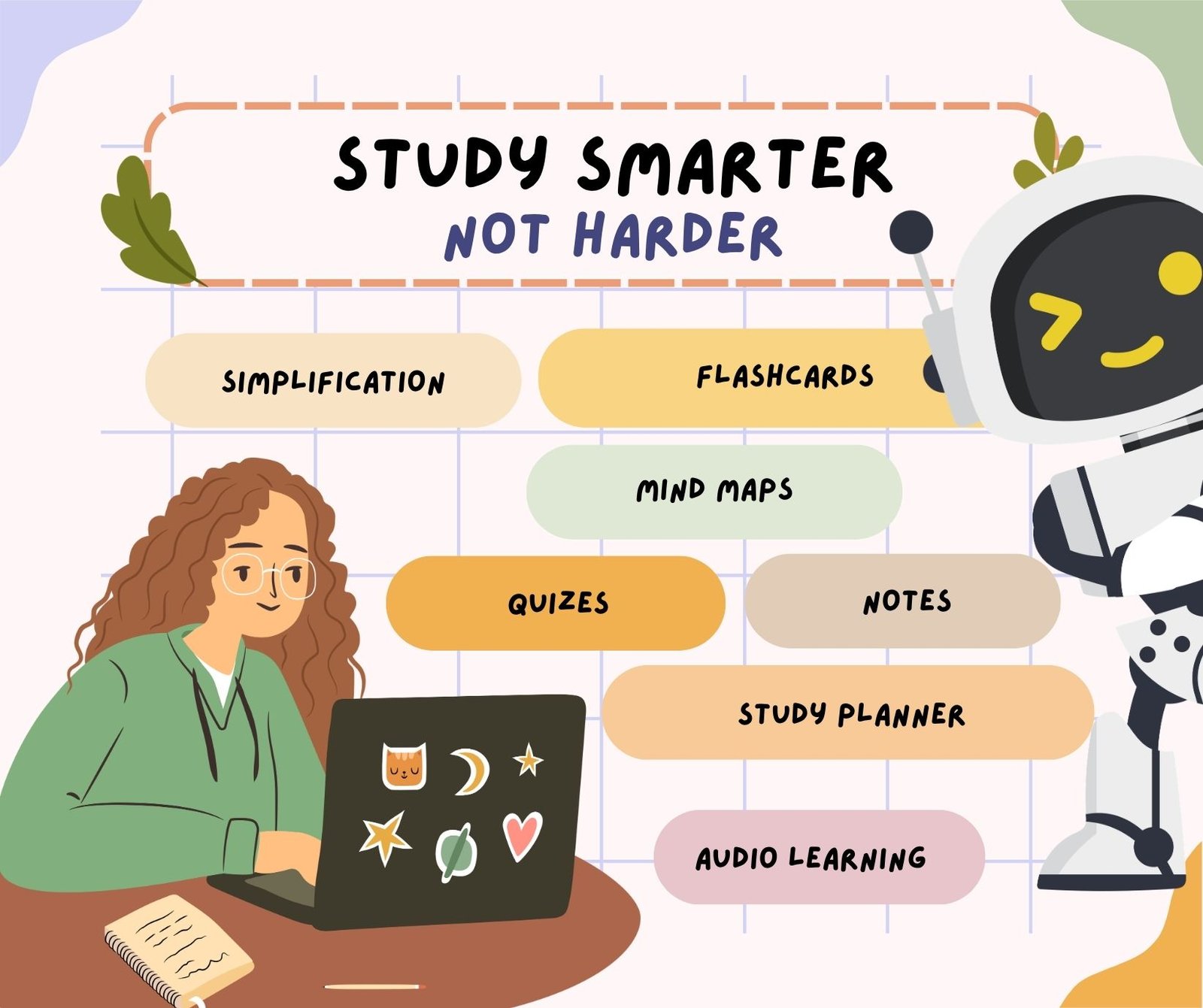
Learning how to study smarter is not about replacing effort with shortcuts. It is about understanding what kind of work your brain needs to do at each stage of learning, then choosing a method that actually supports that work. A difficult concept may need simplification. Several disconnected ideas may need a mind map. Facts that keep disappearing may need flashcards or quizzes. Handwriting can help when you need to slow down and reconstruct an idea, while a podcast can give familiar material another life when you have already spent enough hours staring at the same desk.
The important question is not which study tool is best. It is what problem are you trying to solve with it?
TL;DR: A better way to think about studying
A useful study system moves through six kinds of mental work: understand, process, connect, retrieve, apply and revisit.
When the material is too dense to understand, simplify it before memorizing it. Once the basic idea makes sense, explain it in your own words and use handwriting where slowing down helps. If several concepts remain disconnected, build the relationships through a mind map or diagram. When you need reliable memory, use flashcards and quizzes for retrieval practice. After that, move into real problems or exam-style questions so the knowledge learns how to travel. Finally, return to important material over time, using shorter review sessions or audio when another full desk session is unnecessary.
None of these methods is powerful simply because it exists.
The value comes from using it at the right moment.
Most students are not struggling because they refuse to study. They often need better support.
Most students want to learn. They want to understand the subject, remember what they studied, walk into an exam with confidence and feel that the hours they gave to university actually produced something.
The problem is that effort alone does not tell us how to learn well. Many students were taught what to study long before anyone properly taught them how to study.
Most of us can picture the scene. The table is covered with books, two or three coffee mugs have appeared, and almost the entire chapter has been highlighted. You told yourself you would stop at one, but the next time you properly notice the clock it is three in the morning. The eyes are tired, the dark circles have arrived, and somewhere between another rereading and another cup of coffee, studying has turned into an endurance test.
Nobody could reasonably accuse you of laziness.
Then, the next morning, somebody asks a simple question: “Can you explain what you studied?” After spending the entire night with you, the chapter suddenly behaves as though the two of you have never met.
This is more common than students sometimes admit. Reading the same material repeatedly can make it feel increasingly familiar. Highlighted sentences begin to look known, terminology becomes easier to recognize, and your brain receives the reassuring impression that progress is happening. Yet recognition is not the same as being able to recall, explain or apply an idea later.
A major review of ten common learning techniques rated practice testing and distributed practice among the strongest general-purpose approaches it examined. Rereading and highlighting received much lower utility ratings because their benefits were less consistent across learners and tasks. A later meta-analysis of 242 studies also found especially strong support for distributed practice and practice testing. Sage Journals
That does not mean your highlighter needs to be placed in academic retirement. Highlighting can help you mark important material, and rereading sometimes has a purpose. The mistake is asking these activities to carry the whole burden of learning.
Sometimes the answer is not another hour at the desk.
The next hour simply needs a better job.
Before changing your study method, understand where the learning is breaking down
A difficult study session does not always begin with a difficult subject. Sometimes it begins with something more confusing: you have studied the material, but something still refuses to settle.
You may reach the end of a chapter with a reasonable understanding of every paragraph, yet struggle to explain what the chapter was actually trying to say. In another subject, you may remember the important terms separately but become stuck when an exam asks you to compare them, trace cause and effect, or bring several ideas together inside one argument.
This happens because knowledge often builds in layers. A biology student may understand insulin and blood glucose separately, yet struggle to explain the regulatory system connecting them. An economics student may know inflation, interest rates and consumer demand as individual concepts, but hesitate when asked how a change in one can move through the others. A literature student may understand a character, a historical context and a recurring symbol, yet still find it difficult to bring them together into one convincing interpretation.
Nothing is necessarily missing from memory. Sometimes the connections are missing.
At other times, the problem is completely different. The language may be so dense that all your attention goes into decoding the paragraph before you have enough mental space left to understand the idea. Everything may make sense while the book is open, but disappear when you close it. You might even understand the theory perfectly well and still freeze when an exam asks you to use it in an unfamiliar situation.
These experiences often produce the same reaction: I need to study this again.
That is where a great deal of student time disappears. The material may not need another reading. It may need a different kind of mental work.
| What is happening during study | What may actually be missing | A more useful response |
|---|---|---|
| You keep rereading a difficult section, but only the terminology is becoming familiar. | Too many unfamiliar elements may be competing for limited working memory before a basic mental model has formed. | Simplify the explanation, break it into smaller stages and use worked examples. |
| The explanation feels clear while reading, but becomes vague when you explain it yourself. | Recognition may be stronger than reconstruction. The explanation still belongs more to the textbook than to you. | Close the source, explain it in your own words and write the difficult parts yourself. |
| You have learned several topics separately, but comparisons and cause-and-effect relationships still feel disconnected. | The information may exist as separate pieces without a useful structure linking them. | Build a mind map, process diagram, timeline or comparison table. |
| Yesterday’s material felt clear, but today it takes several hints before the answer returns. | The material may have received plenty of exposure but too little retrieval practice. | Use flashcards, quizzes or closed-book recall, then return to it later. |
| You understand the theory but still struggle with unfamiliar exam questions. | Knowledge has developed, but application has not been practised enough. | Work through practice problems, cases and exam-style questions. |
| You understand the topic but another hour at the desk is producing fatigue rather than attention. | The material may need another encounter rather than another intensive study session. | Use shorter review, spaced recall or an audio explanation while commuting or walking. |
This is why the same method can feel brilliant on Tuesday and almost useless on Thursday. The method has not necessarily changed. The learning problem has.
Imagine preparing for an exam on the cardiovascular system. At first, preload, afterload and cardiac output are unfamiliar concepts competing for attention. A clear explanation helps because understanding has not formed yet. Once those ideas make sense, a different problem appears: how does blood volume influence stroke volume, and how does that eventually affect cardiac output? Now the student needs to see relationships, so a diagram or concept map becomes more useful.
Several days later, the connections make sense, but terminology starts disappearing. Retrieval practice now has a purpose. Finally, a clinical case asks the student to apply several concepts together. At that stage, even the most beautifully organized notes cannot substitute for solving the problem.
The subject has remained the same.
What the brain needs from it has changed.
When a topic feels impossible, simplify before you memorize it
There is a particular kind of textbook paragraph that seems to contain twelve important ideas, seven unfamiliar terms and one sentence that has somehow lasted half a page. You read it once and reach the end carrying only a vague memory of having met the beginning.
So you read it again. This time you go slowly, with the determined expression of somebody trying to negotiate with the author.
The terminology becomes more familiar. Unfortunately, the concept remains somewhere behind the fog.
This is where cognitive load becomes useful for understanding the problem. Working memory has limited capacity, and complex tasks can require several interacting elements to be processed at the same time. Research within cognitive load theory shows why novice learners often benefit from carefully structured explanations and worked examples, particularly when unguided problem solving would require them to juggle too many unfamiliar elements at once. Springer Link
In practical terms, do not begin memorizing technical language when you still do not understand what the process is trying to accomplish.
Suppose you are studying the renin-angiotensin-aldosterone system. A detailed diagram may introduce renin, angiotensinogen, angiotensin I, ACE, angiotensin II, aldosterone, blood vessels and several feedback mechanisms before you have developed a reason for caring about any of them.
A better entrance is a simpler question: what problem is the body trying to solve?
Once you understand that the system helps regulate blood pressure and fluid balance, the technical components have somewhere to belong. You can then return to the detailed pathway with a structure already forming in your mind.
Simplification, when done well, does not make a difficult subject shallow. It creates a staircase into the complexity.
How to simplify without losing the science
A practical method is to explain the same concept at three levels. Begin with a version for someone who has never studied the subject. Then explain it to another student in your course. Finally, return to the formal terminology and level of precision your professor expects.
Each stage should add detail without changing the underlying meaning.
If you can repeat the academic definition but cannot produce the simpler explanation, there is a possibility that the vocabulary is more secure than the understanding.
This is one place where AI can genuinely save students time. Conch’s current tools include Simplify, which is designed to turn dense study material into clearer explanations. The important step is what happens afterward: return to the original material, compare the simplified version with the source, and make sure important conditions or qualifications have not disappeared.
A simpler explanation should help you return to complexity with more confidence.
It should not become a permanent substitute for it.
Handwritten notes: what actually happens when you slow learning down
Digital notes solve many genuine student problems. They are searchable, fast, easy to reorganize and considerably less vulnerable to handwriting that becomes archaeological after midnight.
There is no scientific reason to abandon your laptop.
However, handwriting creates a different kind of interaction with information.
A 2024 meta-analysis combined 24 studies from 21 articles that compared typed and handwritten lecture notes among college students. Taking and reviewing handwritten notes showed a small achievement advantage, while typing produced substantially more notes. DOI
That finding is more useful than the simplistic advice that handwriting is always better.
Typing is very good at capturing information. Handwriting can become valuable when you need to process it.
Because handwriting is slower, you often cannot reproduce every sentence exactly as it arrives. You have to select the important idea, shorten it, reorganize it and translate it into language you understand. When this happens, the lecture has to pass through your judgment before it reaches the page.
That extra decision-making is part of the value.
Does handwriting really create a new neural pathway?
You will often hear that handwriting “creates neural pathways” in the brain. The idea points toward something interesting, but the claim is too simple when stated that way.
A 2024 study recorded high-density EEG data from 36 university students while they either wrote visually presented words by hand with a digital pen or typed them on a keyboard. Handwriting was associated with more elaborate connectivity patterns across several brain regions, particularly in theta and alpha frequency ranges. The researchers suggested that the combination of visual information and precisely controlled hand movements contributes to connectivity patterns relevant to encoding and learning. Frontiers
The study does not prove that writing every lecture by hand permanently creates a special memory pathway, nor does it show that handwriting will always beat typing in every learning situation.
The more careful conclusion is that handwriting involves a richer combination of visual, motor and proprioceptive information. In simple terms, the brain is coordinating what you see with what your hand is doing and where that movement is happening.
That makes handwriting particularly interesting when the act of reconstruction matters.
When handwriting is worth the time
There is little value in copying forty textbook pages by hand simply because somebody told you handwriting is good for memory. That may create excellent forearm endurance and very ordinary revision.
Use handwriting selectively. Close the book and reconstruct a difficult process. Draw the diagram you keep confusing. Write an explanation of a theory in your own language. Work through an equation and explain why each step follows from the previous one.
At the end of a study session, you can also write a short reflection that answers three questions: what now makes sense, what still feels uncertain, and what you need to retrieve again later.
At that point, the notebook has stopped being storage.
It has become evidence of thinking.
Mind maps help when separate topics need to become one picture
Some subjects behave badly when they are forced into straight lines.
History spreads into causes, consequences, political decisions, economic pressures and personalities. Biology contains pathways inside systems inside organisms. A novel can connect theme, character, symbolism, historical context and one apparently innocent dinner scene that your professor has decided means everything.
Traditional notes can store these ideas.
A mind map can show how they relate.
Imagine studying the immune system. You may know the definitions of antigen, antibody, B cell, T cell and memory cell. Yet knowing five definitions does not automatically create a mental model of how an immune response unfolds.
The problem is no longer missing information. The problem is structure.
A map asks different questions. What activates what? Which process comes first? Which concepts belong under the same branch? Where does one mechanism influence another?
Now you are not simply recording facts. You are organizing a system.
A systematic review published in 2025 examined six randomized controlled trials involving undergraduate medical students. Four reported significantly better assessment outcomes with mind maps or concept maps, while two did not find significant differences. Students generally valued these methods for understanding and summarizing complex information. The evidence is encouraging, but it also reminds us that a mind map is a useful tool rather than a learning spell. Springer Link
The brain is not simply “visual”
It is tempting to explain mind maps by saying that humans are visual learners. That is not a good scientific shortcut.
Visual representations can be powerful when spatial structure, hierarchy, comparison or relationships matter. However, the broader claim that students belong to fixed visual, auditory or kinesthetic learning styles, and learn better whenever teaching matches that preferred style, has repeatedly failed to gain convincing empirical support. A 2026 review again concluded that modality-based learning styles lack reliable evidence for their central prediction. ScienceDirect
This is actually good news for students. You do not have to discover which kind of learner you are and remain loyal to it for the rest of university. Instead, choose the representation that fits the knowledge.
Use a timeline when sequence matters. Use a diagram when spatial relationships matter. Build a comparison table when distinctions matter. Choose a mind map when ideas branch, reconnect and influence one another.
Conch Study Sets currently turns one source into structured notes, editable flashcards and a mind map, which makes it easier to move between different representations of the same material.
The useful step is not merely generating the map. Look at the branches and ask whether the relationships are true.
A wrong connection in beautiful colors is still a wrong connection.
Flashcards become useful when familiarity starts pretending to be memory
There is a quiet trick the brain can play during revision. You read a definition once and it feels difficult. The next day, you see it again and the wording becomes easier. After several encounters, the sentence feels so familiar that you begin to assume you know it. Then the exam removes the textbook, asks you to explain the same idea from memory, and you discover that recognizing an answer and producing one are different abilities.
This is the distinction between recognition and retrieval.
When a definition sits on the page, part of the work has already been done for you. The wording, its position and the surrounding paragraph can all act as cues. Once those cues disappear, memory has to locate and reconstruct the information.
Flashcards and quizzes are useful because they deliberately remove the answer and create that moment of retrieval.
A systematic review examined 50 classroom experiments involving 5,374 learners. Retrieval practice benefited learning across different education levels, subjects and assessment formats, with 57 percent of the reported effect sizes classified as medium or large. REMIX
For students, the practical lesson is not simply to create more cards. It is to create moments when the answer is temporarily unavailable and the brain has to search for it.
Suppose you are revising cell biology and have repeatedly read that mitochondria are involved in ATP production through cellular respiration. After enough exposure, that sentence becomes obvious. A stronger test would be to close the notes and explain where the major stages occur, what enters each stage, what leaves it and what changes when oxygen becomes limited.
Any hesitation at that point is useful.
It reveals where understanding or memory still needs work.
Why immediately flipping the card defeats the purpose
Flashcards become much less useful when students read the question, wait half a second and turn the card over. At that point, the activity has quietly returned to recognition.
Give your brain time to search. Attempt the answer before checking it, even when you are uncertain.
If you get something wrong, compare your answer with the source, understand why it was wrong and return to the question later. The mistake is not evidence that revision failed. It is information about where revision should go next.
The quality of the questions matters as well. Flashcards work naturally for vocabulary, formulas, terminology and process steps, but they can also test deeper understanding. A psychology card might ask how classical conditioning differs from operant conditioning. An economics card could ask why an increase in interest rates may reduce consumer spending. A biology card might ask what happens when a particular enzyme becomes unavailable.
Now the card is asking memory to retrieve relationships and reasoning, not simply definitions.
Conch Study Sets can generate editable flashcards from a student’s own source material. That removes some repetitive preparation, but it does not remove the important part. The learning begins when the answer disappears and the student tries to find it again. Conch AI
Spaced practice matters because memory needs more than one meeting
Students often interpret forgetting as proof that studying did not work.
In reality, some forgetting is precisely why returning to material matters.
A chapter that was completely clear on Monday may feel less accessible on Wednesday. The instinct is often frustration, but the difficulty of bringing the idea back can itself become useful practice.
A recent meta-analysis focused specifically on distributed practice in real classroom learning. It examined 22 reports, 31 effect sizes and more than 3,000 learners, finding a moderate advantage for distributing learning across time rather than massing it into one period. PubMed Central (PMC)
This helps explain why twenty minutes of retrieval on Monday, Wednesday and Friday can be more useful for durable learning than repeatedly reviewing the same material during one long Thursday night.
The exact timing will depend on the subject, your level of knowledge and how long you need to remember the material. There is no universal timetable that every student must follow.
The important principle is simpler.
Do not let the first study session become the material’s only appointment with your brain.
Podcasts solve a different student problem: sometimes the subject needs to leave the desk with you
There comes a point during a long academic week when the desk begins to feel less like furniture and more like somebody you need a little space from.
You may still need another encounter with the material. You simply do not need another hour in exactly the same chair, staring at exactly the same page.
Audio offers a different use case.
A chapter studied in the afternoon can return as a conversation on the walk home. Lecture notes can accompany a train ride. A theory can be revisited while cooking, folding laundry or taking a quiet evening walk after several hours indoors.
The important word here is revisited.
Podcasts are often most useful as another encounter with material rather than a replacement for every other kind of studying.
A 2025 scoping review examined 91 publications on podcasts in higher education and found that podcasts are being used for a wide range of educational purposes. However, the authors also highlighted the need for a stronger and clearer evidence base around their pedagogical effects. Edinburgh Research Explorer
A 2026 systematic review in dental education reached a similarly cautious conclusion. Students generally reported high acceptance and perceived usefulness, but the six included studies were heterogeneous and most had high or unclear risk of bias. The researchers therefore described podcasts as promising adjuncts, rather than replacements for established learning methods. PubMed
What should you actually learn through a podcast?
Audio works particularly well for revisiting explanations, theories, narratives and material you already partly understand. The conversational format can also make a topic feel less formal because one speaker can question an idea while another explains or challenges it.
However, audio has clear limits.
If you are learning a complex chemical structure, a detailed anatomy diagram or a long mathematical derivation for the first time, listening alone may leave you trying to hold too much invisible information in working memory. Those topics usually deserve visual or written study first.
Then the audio can come later.
This distinction is important because students sometimes turn podcasts into another form of passive exposure. The episode plays, the headphones are technically present, and twenty minutes later the mind has travelled somewhere completely different while the podcast continued without complaint.
Listening is only study when attention is involved.
What about listening while walking?
There is some evidence that educational podcasts can remain useful during light movement, but the findings should not be turned into a universal claim that walking improves memory.
One study involving medical students and anesthesiology residents compared textbook reading with podcast listening while seated or walking on a treadmill. Across three topics, podcast conditions produced better immediate learning for two topics and broadly comparable retention, while EEG measures of attention did not significantly differ among conditions. The sample and subject area were specific, so the study should not be generalized to every student or every type of material. PubMed Central (PMC)
The practical recommendation is therefore modest.
Use walking or commuting time for reviewing material that already has a foundation. If the topic is difficult, highly visual or completely unfamiliar, give it your full attention first.
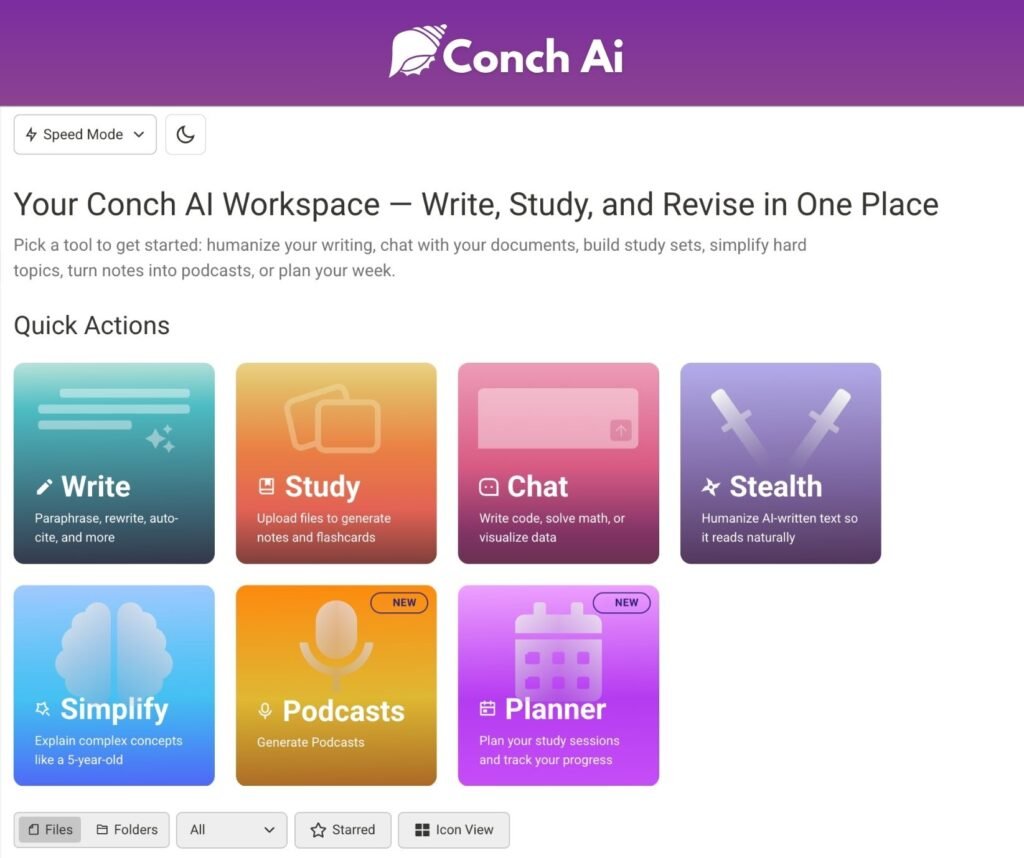
Conch currently includes a Podcast tool alongside study sets, mind maps, quizzes, notes, Simplify and a study planner. That makes it possible for students to carry the same source material into a different study context without rebuilding it from scratch.
The subject can leave the desk.
The learning should not leave with it.
Practice questions are where knowledge discovers whether it can actually move
There is another frustrating student experience that notes and flashcards alone cannot solve.
You understand the theory and remember the definitions.
Then the exam changes the numbers, introduces an unfamiliar case or asks you to apply the concept in a way you have never practised.
Suddenly, the knowledge feels less reliable.
A statistics student may define a test correctly and still choose the wrong one for a research scenario. A chemistry mechanism may make perfect sense while the worked example is visible and become much less cooperative when the molecule changes. A literature student might know the major themes of a novel but struggle to build an argument around a passage they have never seen.
This is not simply forgetting. It is a problem of application and transfer.
Once understanding and retrieval are reasonably secure, study should begin to resemble the eventual assessment. If an exam asks you to solve calculations, solve them. If it gives cases, practise cases. If it requires essays, practise forming arguments without having the perfect paragraph sitting beside you. When the course emphasizes comparison, spend some revision time comparing rather than memorizing each topic in isolation.
Practice questions often feel less pleasant than rereading because they remove some of the support.
That discomfort is useful because it reveals whether the knowledge can travel.
Your exam should not be the first time your understanding is asked to leave home.
One chapter can have several different lives
Imagine you have a chapter on cellular respiration to study.
During the first session, the page looks like a small civilization of molecules, enzymes, arrows and abbreviations. Instead of memorizing everything immediately, you begin by simplifying glycolysis, the Krebs cycle and oxidative phosphorylation until you understand what each stage contributes to the larger process.
Once the structure makes sense, you close the chapter and write a short explanation in your own words. The places where your pen hesitates show you which parts still depend too heavily on the textbook.
The following day, a mind map connects the stages. Glucose, pyruvate, electron carriers, oxygen and ATP stop existing as independent vocabulary terms and begin forming one system.
Next, flashcards test the details that require reliable recall. Some answers appear quickly, while others disappear precisely when requested, which is inconvenient but educationally useful.
Practice questions then change the conditions. What happens if oxygen is unavailable? What changes when part of the pathway is disrupted? Now the knowledge must do something rather than simply exist.
Later, perhaps during the walk home, an audio discussion revisits the chapter in a conversational way. Most of it now sounds familiar, but one explanation catches your attention because you still cannot follow it confidently. That becomes tomorrow’s first study problem.
This is not studying the same chapter six times.
It is asking the same knowledge to perform six different kinds of work.
If something is really important, do not trust one study method with it
Students often ask which technique is best for a major exam.
If the material truly matters, relying on only one method is usually the wrong question.
Consider a concept that may appear in several forms on an exam. First, you need enough understanding to explain what it means. Then you need a structure that connects it with related concepts. You must be able to retrieve important parts without seeing the source. Finally, you need enough practice to use the idea when the question changes.
That combination is much stronger than betting everything on one beautiful set of notes.
For high-value material, a practical sequence is to understand it, explain it from memory, connect it to related ideas, retrieve it again after a delay and then apply it to an unfamiliar question.
The method becomes stronger because each stage reveals a different weakness.
A mind map might show that two processes are still disconnected. A flashcard can expose a missing definition. A practice question can reveal that you remember everything but do not know what to do with it.
Good studying is not merely repetition.
It is repeated diagnosis.
A realistic science-backed study routine
A strong study system does not need to become another complicated productivity project.
Begin by identifying what is unclear. Simplify those parts and use worked examples until the basic idea makes sense. Once you understand the topic, put the important parts into your own words. Handwriting can be especially useful for concepts that need slower reconstruction.
After that, organize the relationships. A mind map, timeline or diagram helps when several ideas belong to a larger system. Then remove the support and retrieve what you know through flashcards, quizzes or a blank sheet of paper.
Once recall becomes reasonably reliable, move into application. Solve the problems, analyse the cases or write the arguments your assessment will eventually require. Finally, return to important material after time has passed instead of allowing every review to happen during one long session.
The overall pattern is simple enough to remember:
Understand → Process → Connect → Retrieve → Apply → Revisit
You do not need every tool for every topic. You need the tool that solves the problem in front of you.
What to do when the exam is close and you are already behind
There is the study plan we imagine at the beginning of the semester, and then there is Thursday evening.
The exam is Friday. Two assignments have arrived together, as assignments sometimes seem to do. A lecture you planned to review last week remains untouched, and the calendar appears to have continued moving without requesting your permission.
This is not the moment to rewrite the entire course. Start by finding the gaps.
Some topics are already understood and retrievable, so they need only a short check. Other material feels familiar, but you cannot explain it without looking. Those areas need retrieval. A smaller number of topics may still be genuinely confusing, and those deserve focused explanation before you attempt to memorize them.
Once the difficult ideas become clear, move quickly toward recall and exam-style practice. If a mind map can clarify a confusing relationship in ten minutes, use it. If the problem is forgotten terminology, use flashcards. If you understand everything but still cannot answer exam questions, stop making notes and start answering questions.
Even within a short window, dividing review across several sessions is usually preferable to one uninterrupted block. The evidence for distributed practice does not disappear simply because the semester became inconvenient. PubMed Central (PMC)
Your goal at this stage is not to recreate the perfect semester overnight.
It is to find the important holes before the exam finds them for you.
AI should remove study friction, not remove the studying
AI has changed something important about student learning.
A few years ago, converting a chapter into organized notes, flashcards, a mind map and an audio review could take so much time that building the study materials became the study session.
Now much of that preparation can happen quickly.
Conch Study Sets can currently take notes, PDFs, slides or other source material and generate structured notes, editable flashcards and a connected mind map from the same material. Conch’s wider study tools also include podcasts, quizzes, notes, simplification and study planning. Conch AI
That can save a student meaningful time.
It can also produce a wonderfully modern form of procrastination.
You can generate fifty polished flashcards without answering one of them. You can create an impressive mind map without checking a single relationship. You can produce an excellent podcast and allow it to play while your thoughts quietly move somewhere else.
The study materials may be ready.
The memory is not.
The best role for AI is therefore to remove repetitive preparation around learning while leaving the mentally valuable work with the student. Let AI organize messy notes, then explain the ideas yourself. Let it generate cards, then attempt the answers before looking. Let it create a mind map, then inspect the important connections. Let it produce audio, then notice where your understanding still breaks.
The efficiency matters only if the saved time returns to thinking.
Do not build your study identity around being a “visual learner”
You may genuinely prefer diagrams. Another student might love audio, while somebody else owns enough stationery to require its own insurance policy.
Preferences are real.
What the evidence does not strongly support is the idea that people belong to fixed visual, auditory or kinesthetic learning types and will learn better simply because instruction matches that category. The central prediction of learning-styles theory has repeatedly failed to receive reliable empirical support. ScienceDirect
A more useful approach is to match the representation to the material.
Anatomy benefits from visual structure because spatial relationships matter. Historical arguments can work well in audio because narrative and explanation matter. Formulas require written practice. Vocabulary needs retrieval. Essays improve through writing and feedback.
You are not one type of learner.
You are a learner facing different kinds of knowledge.
Fortunately, your brain is more flexible than the label.
The best study system is not the one that leaves you most exhausted
There is a strange culture around student tiredness.
Six hours in the library can sound more serious than two focused hours. Studying until sunrise feels almost heroic afterward, although considerably less heroic when sunrise actually arrives and you still cannot remember chapter six.
But exhaustion is not a unit of learning.
A better question at the end of the session is: what can I understand, retrieve or apply now that I could not do when I sat down?
That question is harder to impress with appearances.
It reveals whether the beautifully highlighted chapter can be explained without looking. It shows whether the flashcards produced retrieval or only flipping. It tells you whether the mind map clarified a system or merely became another attractive page. It distinguishes a podcast used for real review from audio that happened to be playing nearby.
Good studying does not remove effort. Learning often requires effort because the mind has to reconstruct, connect and retrieve information.
What a better system removes is wasted effort.
Those are not the same thing.
Perhaps studying smarter is really about noticing what your mind needs next
There is a quiet moment in learning when the subject changes character. A diagram that looked like arrows and labels becomes a process. Three theories that had been sitting separately in your notes begin speaking to one another. A definition that once required a textbook starts arriving from memory. A practice problem that seemed impossible becomes recognizable, not because you have memorized the answer, but because you finally understand what to do.
From the outside, these moments look small.
Inside a student’s mind, they are the reason studying exists.
No single tool can manufacture them. Handwriting can slow an idea down long enough for you to reconstruct it. Simplification can clear a path into difficult material. Mind maps can expose relationships that linear notes hide. Flashcards ask memory to work without the comfort of recognition. Podcasts allow familiar ideas to follow you beyond the desk. Practice questions reveal whether knowledge can survive contact with a new problem.
Each method opens a different door.
The skill is learning which door you are standing in front of.
Perhaps that is what it really means to study smarter. It is not finding a shortcut around learning, nor squeezing more information into fewer hours. It is understanding enough about memory, attention and your own difficulties to give each hour a purpose.
Some chapters will still be difficult, and some nights will still go later than planned. The difference is that your effort no longer has to wander without direction.
Read well. Think deeper.
Frequently Asked Questions
What is the best study method for students?
There is no single method that is best for every stage of learning. Retrieval practice and distributed practice have strong evidence for durable memory, but they solve different problems from simplification, concept mapping, self-explanation or application practice. A better approach is to diagnose whether the main difficulty is understanding, connection, recall or application, then choose the method that addresses it. REMIX
Are handwritten notes better than typing?
Not in every situation. A 2024 meta-analysis of 24 studies found a small achievement advantage for taking and reviewing handwritten notes, while typing allowed students to record substantially more information. A hybrid approach often makes practical sense: type when speed and storage matter, then write by hand when slower reconstruction would help you process a difficult concept. DOI
Do flashcards really help memory?
Flashcards can be effective because they create opportunities for retrieval practice, provided you genuinely attempt the answer before looking. Their value becomes stronger when important material is revisited across separate study sessions rather than massed into one long review. REMIX
Are mind maps useful for studying?
They can be particularly useful when the main difficulty is understanding relationships among concepts. Recent systematic evidence in undergraduate medical education found positive academic outcomes in four of six randomized trials, although results were not uniformly significant. They should therefore be treated as a useful organizational technique, not a guaranteed memory tool. Springer Link
Can I study effectively through podcasts?
Podcasts can be useful for previewing or revisiting material and can make study more flexible when reading is impractical. Current evidence is more convincing for using them as supplementary resources than as replacements for active retrieval, problem solving or close reading. Edinburgh Research Explorer
How can AI help me study smarter?
AI can reduce repetitive setup work by simplifying dense material, organizing notes, generating flashcards, creating concept maps, producing quizzes and turning source material into audio. Those outputs become useful only when students actively explain, retrieve, verify and apply what they contain. Conch currently combines several of these study formats in the same academic workflow. Conch AI
Related Reading
How to Improve Academic English: A Practical Guide for International Students
How to Write an Informative Essay
How to Write a Header for an Essay
How to Write a Biography Essay
How to Write a Reflection Paper
How to Write an Encyclopedia Entry
Why Is My Essay Being Flagged as AI? 11 Reasons—and What to Do
Humanized AI Writing Is More Than AI Detection
Editorial Sources
Van der Weel and Van der Meer, “Handwriting but not typewriting leads to widespread brain connectivity,” Frontiers in Psychology, 2024. This EEG study involved 36 university students and examined connectivity patterns during handwriting and typing. Frontiers
Agarwal, Nunes and Blunt, “Retrieval Practice Consistently Benefits Student Learning,” Educational Psychology Review. The systematic review includes 50 classroom experiments and 5,374 learners. REMIX
“The Distributed Practice Effect on Classroom Learning,” meta-analytic review. The analysis includes more than 3,000 learners and reports an overall advantage for distributed over massed practice. PubMed Central (PMC)
Aljamal et al., systematic review of mind maps and concept maps in undergraduate medical students. Six randomized controlled trials were included, with four reporting significantly higher assessment performance. Springer Link
Thomas et al., “Podcasts as pedagogy in higher education,” British Journal of Educational Technology, 2025. The scoping review maps evidence from 91 publications on educational podcast use. Edinburgh Research Explorer
Patil et al., “Educational Podcasts as Adjuncts for Dental Students,” 2026. The review finds strong student acceptance but notes that objective evidence remains limited and methodologically mixed. PubMed
Current Conch study tools and Study Sets. Product capabilities were checked against Conch’s current official website and Study Sets page before publication. Conch AI
Leave a Reply